
Wrigley S Orbit Bubblemint Pellets 14 g
Wrigley S
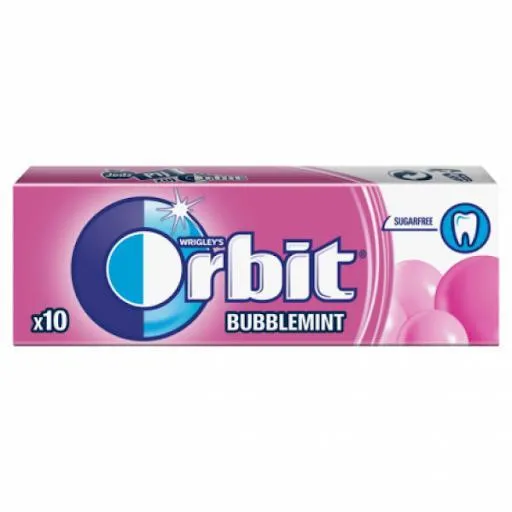
Wrigley S Orbit Bubblemint Pellets comes in a 14 g pack. It is sold under the Wrigley S brand. On Mamori it sits under Confectionery › Chewing Gum. Its label lists 13 ingredients.
Wrigley S Orbit Bubblemint Pellets at a glance
Wrigley S Orbit Bubblemint Pellets fits Vegetarian, Pescatarian, Vegan + Dairy and Vegan + Eggs diets. It also carries the Crustaceans Free, Egg Free, Fish Free, Peanut Free, Dairy Free, Tree Nut Free, Celery Free, Mustard Free, Sesame Free, Sulfite Free, Lupin Free, Mollusks Free, Barley Free, Beef Free, Citrus Fruit Free, Gelatin Free, Lactose Free, Latex Free, Pork Free, Poultry Free, Rice Free, Rye Free, Seed Free and Wheat Free badges. Nutrition-wise, it's Low Salt/Sodium, Low Saturated Fat, Low Sugars, Low Fiber, Low Protein, High Carbs and Medium in Calories. Worth knowing: it's marked Non-Vegan, Non-Low FODMAP, Contains Soy, Contains Additives, Contains Artificial Flavourings, Contains Corn, Contains Emulsifier, Contains Fructose, Contains Added Sugars and Contains Oats.
Diet and allergens
Suitable for vegetarian and pescatarian diets.
Not suitable for a vegan diet.
Contains soy.
Free from crustaceans, eggs, fish, peanuts, milk, tree nuts, celery, mustard, sesame, sulphites, lupin and molluscs.
Based on Mamori's check of the ingredients on the label. Recipes change, so always read the pack if you have an allergy or intolerance.
Size: 14 g
Last updated 26 October 2026
Ingredients
Xylitol, Sorbitol, Aspartame, Mannitol, Acesulfame K, Sucralose, gum base, arabic gum thickener, glycerol humidifier, Aromas, Soy lecithin emulsifier, carnauba wax coating agent, antioxidant bha
Additives & flavourings
Additives
- E967: Xylitol: Generally safe
Xylitol (E967) is a sugar alcohol used as a sweetener. It is found naturally in small amounts in some fruits and vegetables, and is usually made commercially from plant materials such as birch wood or corn cobs.
It sweetens foods with fewer calories than sugar and can also help give a smooth texture. It is commonly used in sugar-free chewing gum, mints, sweets, desserts, and some baked goods.
Xylitol is generally considered safe at normal food amounts. It is allowed in food in the EU after safety assessment, and the sources checked raise no concern for usual consumption.
- E420: Sorbitol (I) Sorbitol (Ii) Sorbitol Syrup (Emulsifier) (Sweetener): Generally safe
Sorbitols (E420) are sugar alcohols used as food additives. They include sorbitol and sorbitol syrup, made from glucose, often from starch sources. Despite the name, they are not alcoholic drinks.
They are used to add sweetness, keep foods moist, improve texture, and help stabilise mixtures. They are often found in sugar-free sweets and chewing gum, desserts, baked goods, sauces, and some processed foods.
Sorbitols are generally considered safe at normal food amounts. They are authorised for use in the EU after safety assessment, and the sources checked raise no concern for typical intake.
- E951: Aspartame: Some concerns
Aspartame (E951) is an artificial intense sweetener. It is made from two amino acids, aspartic acid and phenylalanine, joined with a small methanol component, and is much sweeter than sugar.
It is used to give sweetness with very little energy. It is found in many “diet” or “sugar-free” soft drinks, chewing gum, desserts, yoghurts, tabletop sweeteners and some medicines.
Aspartame is allowed for use, but some concerns have been raised. In 2023, IARC classed it as “possibly causing cancer” (Group 2B), while food safety bodies kept the acceptable daily intake; foods containing it must warn people with phenylketonuria that it contains phenylalanine.
- E421: Mannitol (Anti-Caking Agent): Generally safe
Mannitol (E421) is a sugar alcohol, a type of low-calorie sweetener found naturally in some fruits and vegetables and also made commercially, often from plant sugars. It may also be listed as an anti-caking agent.
In food, it can add sweetness, help control texture, and reduce clumping in powdered products. It is used in some sugar-free sweets and chewing gum, desserts, and other foods where a sugar alcohol or anti-caking effect is needed.
Mannitol is generally considered safe at normal food amounts. It is authorised for use in the EU after safety assessment, and the sources checked raise no concern at typical levels.
- E950: Acesulfame K: Generally safe
Acesulfame K, also called acesulfame potassium or E950, is an artificial sweetener. It is a potassium salt of a synthetic sweet-tasting compound and is much sweeter than sugar, so only small amounts are used.
It is used to sweeten foods and drinks without adding much energy. It is often found in sugar-free or reduced-sugar soft drinks, desserts, chewing gum, tabletop sweeteners and some special dietary foods.
It is generally considered safe at normal amounts. It is authorised for use in the EU after safety assessment, and the sources checked raise no concern when it is used within permitted limits.
- E955: Sucralose (Trichlorogalactosucrose): Generally safe
Sucralose (E955), also called trichlorogalactosucrose, is an artificial high-intensity sweetener. It is made by chemically modifying sugar, which makes it taste very sweet while adding little or no energy in the small amounts used.
It is used to sweeten foods and drinks without using much sugar. You may find it in low-sugar or sugar-free drinks, desserts, yoghurts, chewing gum, tabletop sweeteners, and some special diet foods.
Sucralose is generally considered safe at normal amounts. It is authorised for use in the EU after safety assessment, and the sources checked raise no concern for typical food use.
- E411: Oat Gum (Thickener): Not allowed in the EU (Regulation (EC) No 1333/2008, Article 4(1) and Annex II)
Oat gum, E411, is a food gum obtained from oats. It is mainly made up of soluble fibre, including beta-glucans, and forms a thick, gel-like texture when mixed with water.
It is used as a thickener, stabiliser or emulsifier, helping foods hold moisture, improve texture, or keep ingredients evenly mixed. These functions are used in products such as sauces, dressings, desserts, bakery fillings and other processed foods.
Its safety rating is not yet set here. E411 is allowed in the EU within set limits, meaning it can be used in permitted foods at regulated levels.
- E490: Propane-1,2-Diol: Not allowed in the EU (Regulation (EC) No 1333/2008, Article 4(1) and Annex II)
Propane-1,2-diol, also called propylene glycol, is E490. It is a clear, slightly sweet liquid made from petrochemical or plant-based raw materials. In food use, it belongs to additives that help carry, mix, or stabilise other ingredients.
It can act as a solvent, humectant, stabiliser, or emulsifier, helping flavours, colours, and other ingredients stay evenly mixed or retain moisture. It may be used in flavourings, colour preparations, and some processed foods where these functions are needed.
E490 is allowed in the EU within set limits. Its safety is controlled by maximum permitted levels and conditions of use, but it is not rated here.
- E903: Carnauba Wax: Generally safe
Carnauba wax (E903) is a natural plant wax taken from the leaves of the carnauba palm. It is a hard, glossy wax, also used outside food in coatings and polishes.
In food, it is used as a glazing agent to give a shiny surface and help reduce sticking or moisture loss. It can be found on some sweets, chewing gum, chocolate-coated products, and waxed fruit coatings.
Carnauba wax is generally considered safe at normal food amounts. It is authorised for use in the EU after EFSA safety assessment, and the checked sources raise no concern for typical dietary exposure.
- E324: Ethoxyquin: Not allowed in the EU (Regulation (EC) No 1333/2008, Article 4(1) and Annex II)
Ethoxyquin (E324) is a synthetic antioxidant. It is not a vitamin-type antioxidant, but a manufactured chemical used to slow down oxidation, especially in fats and oils.
In food, antioxidants help prevent rancidity, colour changes, and loss of quality during storage. Ethoxyquin has mainly been used in animal feed and some preserved ingredients where fats need protection, rather than in a wide range of everyday foods.
Safety is treated through legal limits rather than a simple “safe or unsafe” label here. Ethoxyquin is allowed in the EU within set limits, which are intended to control how much can be present in foods or feed.
Flavourings
- Aromas: Flavouring (Regulation (EC) No 1334/2008 on flavourings, Article 16).
Questions and answers
Is Wrigley S Orbit Bubblemint Pellets vegan?
No. It is not suitable for a vegan diet.
Is Wrigley S Orbit Bubblemint Pellets vegetarian?
Yes. It is suitable for a vegetarian diet.
Is Wrigley S Orbit Bubblemint Pellets suitable for a pescatarian diet?
Yes. It is suitable for a pescatarian diet.
Is Wrigley S Orbit Bubblemint Pellets suitable for a Low FODMAP diet?
No. It is not suitable for a Low FODMAP diet.
Is Wrigley S Orbit Bubblemint Pellets suitable for a Vegan + Dairy diet?
Yes. It is suitable for a Vegan + Dairy diet.
Is Wrigley S Orbit Bubblemint Pellets suitable for a Vegan + Eggs diet?
Yes. It is suitable for a Vegan + Eggs diet.
Does Wrigley S Orbit Bubblemint Pellets contain milk?
No. Its ingredients include no milk, and its label gives no milk warning.
Is Wrigley S Orbit Bubblemint Pellets nut-free?
Yes. Its ingredients include no peanuts or tree nuts, and its label gives no nut warning.
Does Wrigley S Orbit Bubblemint Pellets contain eggs?
No. Its ingredients include no eggs, and its label gives no egg warning.
Which allergens does Wrigley S Orbit Bubblemint Pellets contain?
It contains soy.
More in Chewing Gum
- Wrigley's Freedent strawberry
- Bubble Gum
- Orbit Refreshers Peppermint school
- Orbit Refreshers Spearmint
- Mentos Spearmint Gum
- Wrigley's Orbit Sugar Free Peppermint
- Brooklyn Spearmint
- Wrigley's Orbit Spearmint Bottle
- Chupa Chups Cotton Bubble Gum Tutti Frutti
- Wrigley's Orbit White Spearmint Sugar Free
- Big Babol Fruit Juice
- Mentos Gum Bubble Fresh