
Bird's Strawberry Trifle 144 g
Bird's
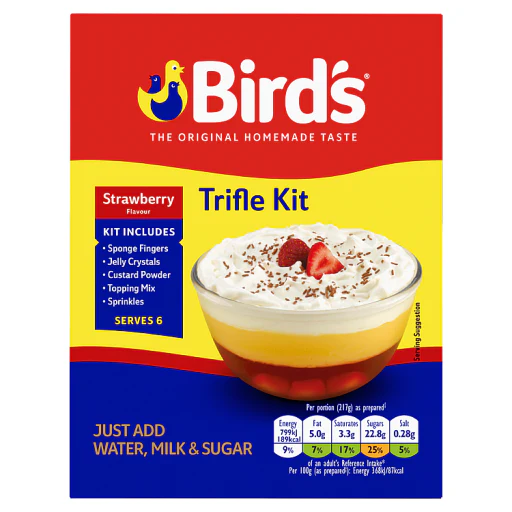
Bird's Strawberry Trifle comes in a 144 g pack. It is sold under the Bird's brand. On Mamori it sits under Groceries › Baking Needs › Cake Mix. Its label lists 50 ingredients.
Bird's Strawberry Trifle at a glance
Bird's Strawberry Trifle carries the Crustaceans Free, Fish Free, Peanut Free, Tree Nut Free, Celery Free, Mustard Free, Sesame Free, Lupin Free, Mollusks Free, Barley Free, Beef Free, Citrus Fruit Free, Gelatin Free, Latex Free, Oats Free, Pork Free, Poultry Free, Rice Free and Rye Free badges. Nutrition-wise, it's Low Carbs, Low Salt/Sodium, Low Fiber, Low Protein, Medium in Calories, Medium Saturated Fat and Medium in Sugars. Worth knowing: it's marked Non-Vegan, Non-Vegetarian, Non-Pescatarian, Non-Low FODMAP, Non-Vegan + Dairy, Non-Vegan + Eggs, Contains Gluten, Contains Egg, Contains Dairy, Contains Additives, Contains Artificial Flavourings, Contains Corn, Contains Emulsifier, Contains Fructose, Lactose, Contains Added Sugars, Contains Seed and Contains Wheat.
Diet and allergens
Not suitable for vegan, vegetarian or pescatarian diets.
Contains gluten, eggs and milk.
Free from crustaceans, fish, peanuts, tree nuts, celery, mustard, sesame, lupin and molluscs.
Based on Mamori's check of the ingredients on the label. Recipes change, so always read the pack if you have an allergy or intolerance.
Size: 144 g
Last updated 2 November 2026
Ingredients
sugar, wheat flour, egg, glucose-fructose syrup, raising agent: ammonium hydrogen carbonate, flavouring, strawberry flavour jelly crystals, sugar, gelling agents, carrageenan, dipotassium phosphate, potassium chloride, colours, beetroot red, annatto, adipic acid, cream of tartar, thickener: carboxymethyl cellulose, flavouring, sweetener: saccharin, custard powder, cornflour, salt, colour: annatto, flavouring, trifle topping mix, hydrogenated vegetable oil, sugar, emulsifiers, propane-1, 2-diol esters of fatty acids, sunflower lecithin, modified starch, whey powder from milk, milk lactose, milk proteins, anti-caking agent: silicon dioxide, thickener: carboxymethyl cellulose, flavouring, colour: beta-carotene, decorative sprinkles, sugar, wheat starch, wheat flour, vegetable oil, fat-reduced cocoa powder, emulsifier: sunflower lecithin, glazing agents, gum arabic, shellac
Additives & flavourings
Additives
- E503: Ammonium Carbonates: (I) Ammonium Carbonate (Ii) Ammonium Bicarbonate (Ammonium Hydrogen Carbonate): Generally safe
Ammonium carbonates (E503) are raising agents made up of ammonium carbonate and ammonium bicarbonate, also called ammonium hydrogen carbonate. They are simple inorganic salts that release gas when heated.
In food, E503 helps doughs and batters rise, especially in baked goods such as biscuits, crackers and some traditional baked products. It can also act as an acidity regulator or anti-caking agent in some uses.
It is generally considered safe at normal food levels. E503 is allowed in food in the EU after safety assessment, and the sources checked raise no concern for typical amounts used in foods.
- E407: Carrageenan (Thickener) (Stabiliser) (Gelling Agent): Some concerns
Carrageenan, or E407, is a thickening and gelling additive made from red seaweed. It is a large carbohydrate substance used to change the texture of foods.
It helps foods become thicker, creamier or more stable, and can also help gels form. It is often used in dairy desserts, flavoured milks, ice cream, plant-based drinks, sauces and processed meats.
It is allowed in food, but some concerns have been raised. EFSA found that people who eat a lot of foods containing carrageenan could go over the safe daily amount, so high intake is the main issue.
- E340: Potassium Phosphates (I) Monopotassium Phosphate (Ii) Dipotassium Phosphate (Iii) Tripotassium Phosphate: Some concerns
Potassium phosphates (E340) are potassium salts of phosphoric acid. The group includes monopotassium phosphate, dipotassium phosphate and tripotassium phosphate. They are mineral-based phosphates used as acidity regulators and antioxidant-related stabilisers.
In food, E340 helps control acidity, stabilise mixtures, bind water and support texture. It may be used in processed meats, processed cheese, bakery products, powdered drinks, desserts and other processed foods where phosphate salts are useful.
E340 is allowed in food, but some concerns have been raised. EFSA found that people who eat many foods containing added phosphates can exceed the safe daily amount, and phosphate intake is a particular concern for people with kidney disease.
- E508: Potassium Chloride (Gelling Agent): Some concerns
Potassium chloride (E508) is a potassium salt, similar in structure to table salt but containing potassium instead of sodium. It is used as an acidity regulator, anti-caking agent and firming or gelling aid in some foods.
In food, it can help control acidity, improve texture, prevent powders from clumping, or partly replace ordinary salt. It may be found in processed foods such as seasonings, low-sodium salt products, soups, sauces, and some canned or prepared foods.
It is allowed for use, but some concerns have been raised. EFSA found that people with high intakes of foods containing potassium chloride could exceed the safe daily amount.
- E160B: Annatto, Bixin, Norbixin (E160b): Generally safe
Annatto, bixin and norbixin are orange-red colourings known as E160b. They are natural pigments extracted from the seeds of the annatto tree. Bixin is oil-soluble, while norbixin is water-soluble.
They are used to give foods a yellow, orange or red colour. They are commonly used in foods such as cheese, butter-like spreads, snacks, desserts and processed foods where a stable colour is needed.
E160b is generally considered safe at normal amounts. It is allowed in food in the EU after EFSA safety assessment, and the sources checked raise no concern for typical dietary exposure.
- E355: Adipic Acid: Generally safe
Adipic acid, or E355, is an acidity regulator. It is an organic acid, usually made industrially, and is related to acids that can occur in small amounts in some natural foods.
It is used to adjust tartness and control acidity in foods and drinks. It may be found in products such as powdered dessert mixes, fillings, confectionery, flavoured drinks, and other foods where a steady sour taste or pH control is needed.
Adipic acid is generally considered safe at normal food-use levels. It is authorised for use in the EU after safety assessment, and the sources checked raise no specific concern at typical amounts.
- E336: Potassium Tartrates (I) Monopotassium Tartrate (Cream Of Tartar) (Ii) Dipotassium Tartrate: Generally safe
Potassium tartrates (E336) are salts of tartaric acid, a natural acid found in grapes and other fruits. The main forms are monopotassium tartrate, often called cream of tartar, and dipotassium tartrate.
They are used as acidity regulators and can also help stabilise foods. Cream of tartar is commonly used in baking powders and in whisked egg whites, while potassium tartrates may also be used where control of acidity is needed.
E336 is allowed in food in the EU after safety assessment. It is generally considered safe at normal food levels, and the sources checked raise no concern for typical use.
- E466: Sodium Carboxy Methyl Cellulose, Cellulose Gum: Generally safe
Sodium carboxy methyl cellulose, also called cellulose gum or E466, is a modified cellulose. Cellulose is a natural fibre found in plant cell walls, and E466 is made by chemically changing it so it dissolves or disperses in water.
It is used as a thickener, stabiliser and emulsifier. It helps give foods a smooth texture, keep ingredients mixed, and control thickness. It can be found in products such as sauces, dressings, desserts, ice cream, baked goods and some reduced-fat foods.
E466 is generally considered safe. It is authorised for use in the EU after safety assessment, and the sources checked raise no concern at normal food amounts.
- E954: Saccharin And Its Na, K And Ca Salts: Generally safe
Saccharin and its sodium, potassium and calcium salts (E954) are intense artificial sweeteners. They are not sugars, and are used in very small amounts because they taste much sweeter than sugar.
They sweeten foods and drinks without adding much energy. E954 may be found in low-sugar or sugar-free products such as soft drinks, desserts, sweets, chewing gum and tabletop sweeteners.
It is generally considered safe at normal amounts. Saccharin is allowed in food in the EU after safety assessment, and the sources checked raise no concern for typical food use.
- E944: Propane: Generally safe
Propane (E944) is a food-grade gas. It is a simple hydrocarbon, the same type of substance as other light gases used under pressure, and is not a sweetener despite sometimes appearing in broad additive categories.
In food, propane is mainly used as a propellant or packaging gas, helping push products out of aerosol containers or create pressure in certain food applications. It may be used where food gases are needed rather than for taste, colour, or nutrition.
It is generally considered safe at normal food-use levels. Propane is authorised for use in food in the EU after safety assessment, and the sources checked raise no concern at typical amounts.
- E477: Propane-1,2-Diol Esters Of Fatty Acids, Propylene Glycol Esters Of Fatty Acids: Generally safe
Propane-1,2-diol esters of fatty acids (E477), also called propylene glycol esters of fatty acids, are emulsifiers made by combining propylene glycol with fatty acids. The fatty acids can come from vegetable or animal sources.
E477 helps oil and water mix, improves texture, and can help stabilise foods. It may be used in products such as cakes, whipped toppings, desserts, confectionery, and fat-based spreads, where a smooth or stable texture is needed.
E477 is generally considered safe at normal food-use levels. It is authorised for use in the EU after safety assessment, and the sources checked raise no concern at typical amounts.
- E1401: Modified Starch ((Acid-Treated Starch) Stabiliser): Generally safe
Acid-treated starch, often labelled E1401 in some systems, is a modified starch. It is made by treating ordinary starch from plants such as maize, potato or wheat with acid to change how it behaves in food.
It helps thicken, stabilise or improve texture, especially where a smooth, consistent result is needed. Modified starches are used in foods such as sauces, soups, desserts, fillings and processed meals.
It is generally considered safe. Under EU law, acid-treated starch is not classed as a food additive; it is treated as a food ingredient instead.
- E551: Silicon Dioxide (Silica): Generally safe
Silicon dioxide (E551), also called silica, is a naturally occurring mineral substance made of silicon and oxygen. It is found in rocks, sand and many plants, and the food additive form is a fine, inert powder.
In food, it is mainly used as an anti-caking agent to help powders and granules flow freely. It may be found in products such as powdered seasonings, salt substitutes, dried soups, instant drinks and food supplement powders.
It is generally considered safe at normal food-use levels. It is authorised for use in the EU after safety assessment, and the sources checked raise no concern at typical amounts.
- E160a: Carotenes: Generally safe
Carotenes (E160a) are orange-yellow colourants, including alpha-carotene, beta-carotene and gamma-carotene. They are pigments found naturally in plants such as carrots and leafy greens, and can also be made synthetically or obtained from natural sources. Some forms may be animal derived.
They are used to add or restore yellow to orange colour in foods. They may be found in products such as margarines, dairy products, desserts, sauces, drinks and confectionery.
E160a is allowed in food in the EU after safety assessment. It is generally considered safe at normal food amounts, and the sources checked raise no concern for typical use.
- E414: Gum Arabic (Acacia Gum): Generally safe
Gum arabic, or acacia gum, is E414. It is a natural gum obtained from the dried sap of acacia trees. It is a soluble dietary fibre made mainly of complex carbohydrates.
In food, it is used as a thickener, stabiliser and emulsifier. It helps keep mixtures even, improves texture, and can help hold flavours or colours in place. It may be found in sweets, soft drinks, icings, baked goods and flavourings.
It is generally considered safe at normal food amounts. It is authorised for use in the EU after safety assessment, and the sources checked raise no concern for typical use.
- E904: Shellac: Generally safe
Shellac (E904) is a natural resin secreted by the lac insect. It is collected, purified, and used as a food-grade glazing agent. Because it comes from insects, it may not be suitable for people avoiding animal-derived ingredients.
In food, shellac gives a shiny protective coating and can help reduce moisture loss. It is typically used on confectionery, chocolate-coated items, nuts, coffee beans, and some fresh fruit coatings.
Shellac is generally considered safe at normal food-use levels. It is authorised for use in the EU after safety assessment, and the sources checked do not raise concerns for typical amounts.
Flavourings
- flavouring: Flavouring (Regulation (EC) No 1334/2008 on flavourings, Article 16).
- flavouring: Flavouring (Regulation (EC) No 1334/2008 on flavourings, Article 16).
- flavouring: Flavouring (Regulation (EC) No 1334/2008 on flavourings, Article 16).
- flavouring: Flavouring (Regulation (EC) No 1334/2008 on flavourings, Article 16).
Questions and answers
Is Bird's Strawberry Trifle vegan?
No. It contains eggs and milk, so it is not suitable for a vegan diet.
Is Bird's Strawberry Trifle vegetarian?
No. It is not suitable for a vegetarian diet.
Is Bird's Strawberry Trifle suitable for a pescatarian diet?
No. It is not suitable for a pescatarian diet.
Is Bird's Strawberry Trifle suitable for a Low FODMAP diet?
No. It is not suitable for a Low FODMAP diet.
Is Bird's Strawberry Trifle suitable for a Vegan + Dairy diet?
No. It is not suitable for a Vegan + Dairy diet.
Is Bird's Strawberry Trifle suitable for a Vegan + Eggs diet?
No. It is not suitable for a Vegan + Eggs diet.
Is Bird's Strawberry Trifle gluten-free?
No. It contains gluten.
Does Bird's Strawberry Trifle contain milk?
Yes. It contains milk.
Is Bird's Strawberry Trifle nut-free?
Yes. Its ingredients include no peanuts or tree nuts, and its label gives no nut warning.
Does Bird's Strawberry Trifle contain eggs?
Yes. It contains eggs.
Which allergens does Bird's Strawberry Trifle contain?
It contains gluten, eggs and milk.
More in Cake Mix
- Paneangeli Potato Starch
- Mississippi Belle Devils Food Cake Mix
- Green's Greens Vanilla Sponge Mix
- Mississippi Belle Fudge Brownie Mix
- Mississippi Belle Cheese Cake Mix
- Betty Crocker Vanilla Cake Mix
- Betty Crocker Red Velvet Cake Mix
- Peak's Cake Mix Vanilla
- Peak's Cake Mix Lemon
- Mr Kipling Space Chocolate Cake Mix
- Mr Kipling Llama Caramel Flavour Cake Mix
- Mr Kipling Unicorn Cake Mix