
Betty Crocker Red Velvet Cake Mix 425 g
Betty Crocker
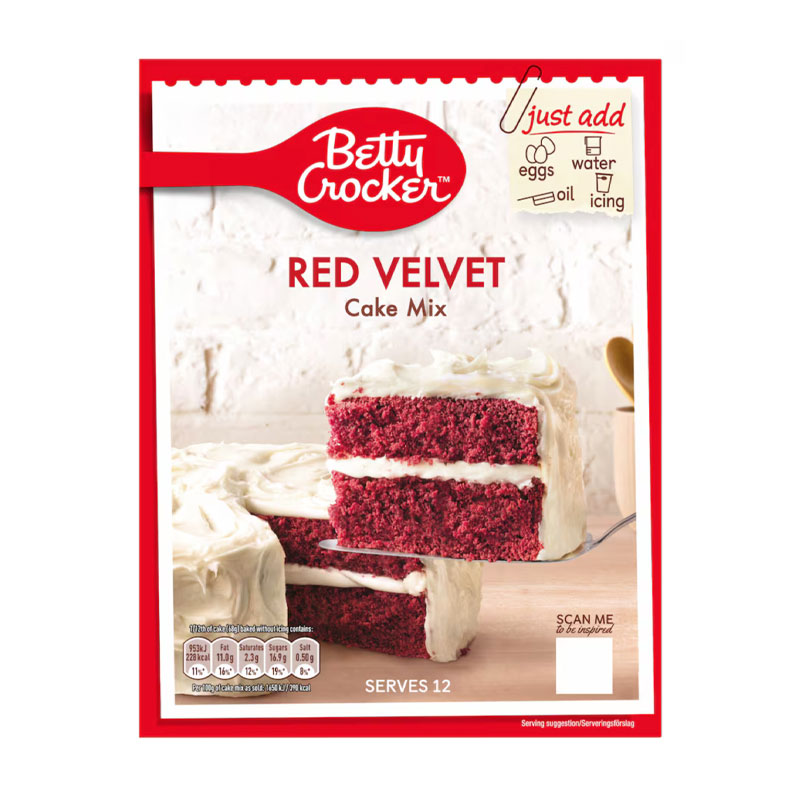
Betty Crocker Red Velvet Cake Mix comes in a 425 g pack. It is sold under the Betty Crocker brand. On Mamori it sits under Groceries › Baking Needs › Cake Mix. Its label lists 27 ingredients.
Betty Crocker Red Velvet Cake Mix at a glance
Betty Crocker Red Velvet Cake Mix fits Vegetarian, Pescatarian, Vegan + Dairy and Vegan + Eggs diets. It also carries the Crustaceans Free, Egg Free, Fish Free, Peanut Free, Dairy Free, Tree Nut Free, Celery Free, Mustard Free, Sesame Free, Sulfite Free, Lupin Free, Mollusks Free, Barley Free, Beef Free, Citrus Fruit Free, Gelatin Free, Lactose Free, Latex Free, Oats Free, Pork Free, Poultry Free, Rice Free and Rye Free badges. Nutrition-wise, it's Low Calorie, Low Carbs, Low Salt/Sodium, Low Protein, Medium in Fiber, Medium Saturated Fat and Medium in Sugars. Worth knowing: it's marked Non-Vegan, Non-Low FODMAP, Contains Gluten, Contains Soy, Contains Additives, Contains Artificial Flavourings, Contains Corn, Contains Emulsifier, Contains Fructose, Contains Added Sugars, Contains Seed and Contains Wheat.
Diet and allergens
Suitable for vegetarian and pescatarian diets.
Not suitable for a vegan diet.
Contains gluten and soy.
Free from crustaceans, eggs, fish, peanuts, milk, tree nuts, celery, mustard, sesame, sulphites, lupin and molluscs.
Based on Mamori's check of the ingredients on the label. Recipes change, so always read the pack if you have an allergy or intolerance.
Size: 425 g
Last updated 2 November 2026
Ingredients
enriched flour bleached, wheat flour, niacin, iron, thiamin mononitrate, riboflavin, folic acid, sugar, corn syrup, leavening, baking soda, monocalcium phosphate, sodium aluminum phosphate, cocoa processed with alkali, corn starch, modified corn starch, partially hydrogenated soybean oil, partially hydrogenated cottonseed oil, propylene glycol mono and diesters of fatty acids, distilled monoglycerides, salt, dicalcium phosphate, sodium stearoyl lactylate, red 40, xanthan gum, cellulose gum, artificial flavor
Additives & flavourings
Additives
- E341: Calcium Phosphates (I) Monocalcium Phosphate (Ii) Dicalcium Phosphate (Iii) Tricalcium Phosphate: Some concerns
Calcium phosphates (E341) are mineral salts of calcium and phosphate. The group includes monocalcium phosphate, dicalcium phosphate and tricalcium phosphate, and they are forms of the same nutrients found naturally in bones and teeth.
They are used to control acidity, help powders flow, support raising agents, and sometimes add calcium. They can be found in foods such as flour mixes, baked goods, powdered drinks, processed cheese, and some supplements or fortified foods.
They are allowed in food, but there are some concerns. EFSA found that people who eat a lot of foods containing phosphate additives can exceed the safe daily amount, and people with kidney disease are often advised to limit phosphate intake.
- E541: Sodium Aluminium Phosphate (I) Acidic (Ii) Basic: Generally safe
Sodium aluminium phosphate acidic (E541) is an inorganic phosphate salt made from sodium, aluminium and phosphate. In food additive lists, E541 can refer to acidic or basic forms of sodium aluminium phosphate.
It is used mainly as a raising agent and acidity regulator, helping baked goods rise and giving a more consistent texture. It may also act as an anti-caking agent in dry mixes, such as baking powders or flour-based preparations.
E541 is generally considered safe at normal food levels. It is authorised for use in the EU after safety assessment, and the checked sources raise no concern for typical amounts in food.
- E477: Propane-1,2-Diol Esters Of Fatty Acids, Propylene Glycol Esters Of Fatty Acids: Generally safe
Propane-1,2-diol esters of fatty acids (E477), also called propylene glycol esters of fatty acids, are emulsifiers made by combining propylene glycol with fatty acids. The fatty acids can come from vegetable or animal sources.
E477 helps oil and water mix, improves texture, and can help stabilise foods. It may be used in products such as cakes, whipped toppings, desserts, confectionery, and fat-based spreads, where a smooth or stable texture is needed.
E477 is generally considered safe at normal food-use levels. It is authorised for use in the EU after safety assessment, and the sources checked raise no concern at typical amounts.
- E472G: Succinylated Monoglycerides (E472g): Not allowed in the EU (Regulation (EC) No 1333/2008, Article 4(1) and Annex II)
Succinylated monoglycerides (E472g) are modified fats made by reacting mono- and diglycerides of fatty acids with succinic acid. They belong to a group of emulsifiers based on glycerides, which are fat-like substances.
They help oil and water mix, improve texture, and can stabilise or thicken foods. They may be used in baked goods, desserts, toppings, and other processed foods where a smooth or stable texture is needed.
E472g is allowed in the EU within set limits. It has not been given a rating here, so it is best described neutrally as a permitted additive when used according to food additive regulations.
- E481: Sodium Stearoyl-2-Lactylate: Some concerns
Sodium stearoyl-2-lactylate (E481) is an emulsifier and stabiliser made by combining stearic acid with lactic acid, then forming the sodium salt. The stearic acid can come from vegetable or animal fats.
It helps oil and water mix, strengthens dough, improves texture, and can help foods stay soft for longer. It is used especially in bread and bakery products, and may also be found in some desserts, processed potato products, and emulsified foods.
It is allowed in food, but some concerns have been raised. EFSA found that people who eat a lot of foods containing it could go over the safe daily amount.
- E129: Allura Red Ac (Fd&C Red 40): Some concerns
Allura Red AC (E129), also known as FD&C Red 40, is a synthetic red azo dye. It is a water-soluble colourant made for use in foods and drinks.
It gives a bright red to orange-red colour and is used in some sweets, soft drinks, desserts, ice lollies, bakery decorations and snack foods.
It is allowed for use, and EFSA’s 2015 assessment did not find a risk of eating too much at typical exposure levels. However, in the EU, foods containing it must carry a warning that it may have an adverse effect on activity and attention in children.
- E415: Xanthan Gum (Thickener): Generally safe
Xanthan gum (E415) is a thickening and stabilising gum made by fermenting sugars with the bacterium Xanthomonas campestris, then purifying and drying the resulting substance.
It helps foods hold water, thicken, and keep ingredients evenly mixed. It is often used in sauces, dressings, desserts, bakery products, gluten-free foods, and drinks where a smooth or stable texture is needed.
Xanthan gum is generally considered safe. It is allowed in food in the EU after EFSA assessment, and the sources checked do not raise concerns at normal amounts used in foods.
- E466: Sodium Carboxy Methyl Cellulose, Cellulose Gum: Generally safe
Sodium carboxy methyl cellulose, also called cellulose gum or E466, is a modified cellulose. Cellulose is a natural fibre found in plant cell walls, and E466 is made by chemically changing it so it dissolves or disperses in water.
It is used as a thickener, stabiliser and emulsifier. It helps give foods a smooth texture, keep ingredients mixed, and control thickness. It can be found in products such as sauces, dressings, desserts, ice cream, baked goods and some reduced-fat foods.
E466 is generally considered safe. It is authorised for use in the EU after safety assessment, and the sources checked raise no concern at normal food amounts.
Flavourings
- artificial flavor: Flavouring (Regulation (EC) No 1334/2008 on flavourings, Article 16).
Questions and answers
Is Betty Crocker Red Velvet Cake Mix vegan?
No. It is not suitable for a vegan diet.
Is Betty Crocker Red Velvet Cake Mix vegetarian?
Yes. It is suitable for a vegetarian diet.
Is Betty Crocker Red Velvet Cake Mix suitable for a pescatarian diet?
Yes. It is suitable for a pescatarian diet.
Is Betty Crocker Red Velvet Cake Mix suitable for a Low FODMAP diet?
No. It is not suitable for a Low FODMAP diet.
Is Betty Crocker Red Velvet Cake Mix suitable for a Vegan + Dairy diet?
Yes. It is suitable for a Vegan + Dairy diet.
Is Betty Crocker Red Velvet Cake Mix suitable for a Vegan + Eggs diet?
Yes. It is suitable for a Vegan + Eggs diet.
Is Betty Crocker Red Velvet Cake Mix gluten-free?
No. It contains gluten.
Does Betty Crocker Red Velvet Cake Mix contain milk?
No. Its ingredients include no milk, and its label gives no milk warning.
Is Betty Crocker Red Velvet Cake Mix nut-free?
Yes. Its ingredients include no peanuts or tree nuts, and its label gives no nut warning.
Does Betty Crocker Red Velvet Cake Mix contain eggs?
No. Its ingredients include no eggs, and its label gives no egg warning.
Which allergens does Betty Crocker Red Velvet Cake Mix contain?
It contains gluten and soy.
More in Cake Mix
- Paneangeli Potato Starch
- Mississippi Belle Devils Food Cake Mix
- Green's Greens Vanilla Sponge Mix
- Mississippi Belle Fudge Brownie Mix
- Mississippi Belle Cheese Cake Mix
- Bird's Strawberry Trifle
- Betty Crocker Vanilla Cake Mix
- Peak's Cake Mix Vanilla
- Peak's Cake Mix Lemon
- Mr Kipling Space Chocolate Cake Mix
- Mr Kipling Llama Caramel Flavour Cake Mix
- Mr Kipling Unicorn Cake Mix