
Aptamil Pronutra Advance Stage 2 400 g
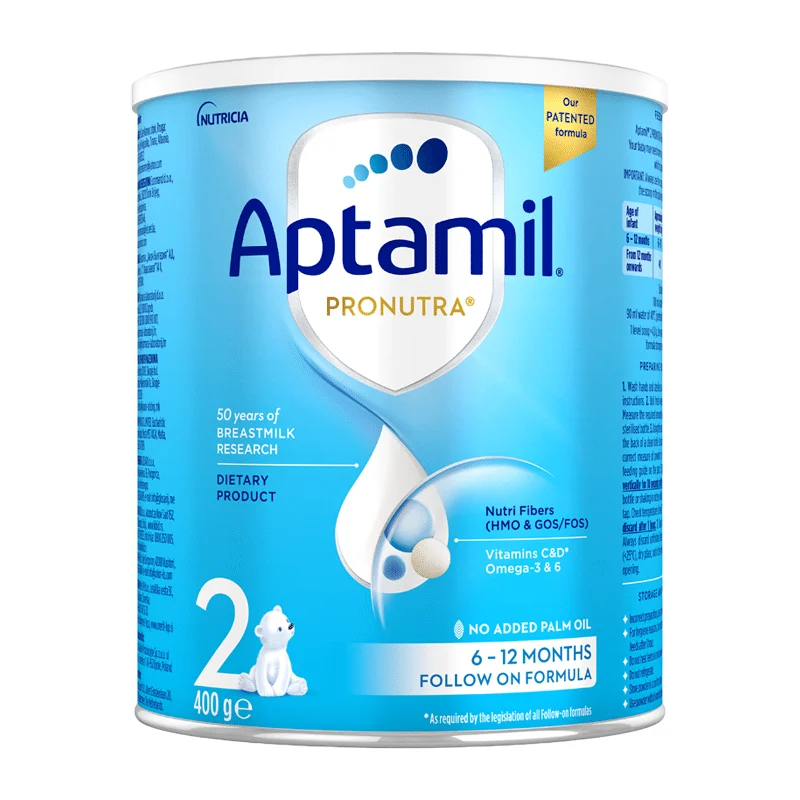
Aptamil Pronutra Advance Stage 2 comes in a 400 g pack. On Mamori it sits under Snacks › Kids & Baby Snacks › Infant Formula. Its label lists 49 ingredients.
Aptamil Pronutra Advance Stage 2 at a glance
Aptamil Pronutra Advance Stage 2 carries the Gluten Free, Crustaceans Free, Egg Free, Peanut Free, Tree Nut Free, Celery Free, Mustard Free, Sesame Free, Sulfite Free, Lupin Free, Mollusks Free, Barley Free, Beef Free, Citrus Fruit Free, Fructose Free, Gelatin Free, Latex Free, Oats Free, Pork Free and Rye Free badges. Nutrition-wise, it's Low Salt/Sodium, Low Saturated Fat, Low Sugars, Low Fiber, Low Protein, Medium in Calories and Medium Carbs. Worth knowing: it's marked Non-Vegan, Non-Vegetarian, Non-Pescatarian, Non-Low FODMAP, Non-Vegan + Dairy, Non-Vegan + Eggs, Contains Fish, Contains Soy, Contains Dairy, Contains Additives, Contains Artificial Flavourings, Contains Corn, Contains Emulsifier, Lactose, Contains Added Sugars, Contains Poultry, Contains Rice, Contains Seed and Contains Wheat.
Diet and allergens
Not suitable for vegan, vegetarian or pescatarian diets.
Contains fish, soy and milk.
Free from gluten, crustaceans, eggs, peanuts, tree nuts, celery, mustard, sesame, sulphites, lupin and molluscs.
Based on Mamori's check of the ingredients on the label. Recipes change, so always read the pack if you have an allergy or intolerance.
Size: 400 g
Last updated 2 November 2026
Ingredients
lactose, vegetable oils, palm oil, rapeseed oil, coconut oil, sunflower oil, single cell oil, maltodextrin, skimmed milk, whey protein concentrate, galacto-oligosaccharide QUID, calcium carbonate, fish oil, tri potassium citrate, calcium chloride, choline chloride, l-ascorbic acid, sodium l-ascorbate, taurine, emulsifier: soy lecithin, ferrous sulphate, tri calcium phosphate, magnesium chloride, inositol, dl-alpha tocopheryl acetate, zinc sulphate, l-tryptophan, disodium uridine 5'-monophosphate, cytidine 5'-monophosphate, adenosine 5'-monophosphate, inosine 5-monophosphate sodium salt, nicotinamide, l-carnitine, guanosine 5'-monophosphate sodium salt, calcium d-pantothenate, pteroylmonoglutamic acid, cupric sulphate, retinyl palmitate, dl-alpha-tocopherol, d-biotin, thiamin hydrochloride, cholecalciferol, cyanocobalamin, pyridoxine hydrochloride, riboflavin, manganese sulphate, potassium iodide, phytomenadione, sodium selenite
Additives
- E170: Calcium Carbonate, Chalk: Generally safe
Calcium carbonate (E170), also known as chalk, is a naturally occurring mineral made of calcium, carbon and oxygen. For food use it is purified, and it may come from sources such as limestone or shells.
It is mainly used as a white colourant, but it can also help with acidity control, anti-caking, or as a calcium source in some foods. It may be found in confectionery, chewing gum, bakery products, decorations and some supplements or fortified foods.
It is generally considered safe at normal food amounts. It is authorised for use in the EU after safety assessment, and the sources checked raise no concern for typical dietary exposure.
- E332: Potassium Citrates (I) Monopotassium Citrate (Ii) Potassium Citrate (Tripotassium Citrate): Generally safe
Potassium citrates (E332) are potassium salts of citric acid, a natural acid found in citrus fruits. They include monopotassium citrate and tripotassium citrate, and are used as acidity regulators and antioxidants.
In food, they help control acidity, stabilise flavour, and can slow changes caused by oxidation. They may be used in products such as drinks, jams, confectionery, processed cheese, and other foods where acidity control is needed.
Potassium citrates are generally considered safe at normal food amounts. They are authorised for use in the EU after safety assessment, and the sources checked raise no concern for typical dietary exposure.
- E509: Calcium Chloride (Sequestrant): Some concerns
Calcium chloride (E509) is a salt made from calcium and chloride. In food, it is used as an acidity regulator, firming agent, stabiliser, and anti-caking agent.
It can help keep fruit and vegetables firm, support cheese making, improve texture in tofu, and prevent powders or salts from clumping. It may also be used where control of acidity or mineral balance is needed.
It is allowed for use in food, but some concerns have been raised about high intakes. EFSA found that people who consume a lot of foods containing calcium chloride could exceed the safe daily amount.
- E1001: Choline Salts: Not allowed in the EU (Regulation (EC) No 1333/2008, Article 4(1) and Annex II)
Choline salts, E1001, are salts of choline, a vitamin-like nutrient related to the B-vitamin group. They are usually made by combining choline with acids or minerals to form stable compounds.
In food, they may be used to add choline or help with formulation in products where this nutrient is needed, such as some fortified foods, food supplements or foods for special nutritional purposes.
Safety is not rated here. Choline salts are allowed in the EU within set limits, which are intended to keep use at acceptable levels.
- E300: Ascorbic Acid (Vitamin C): Generally safe
Ascorbic acid (E300) is vitamin C, a water-soluble substance found naturally in many fruits and vegetables. As a food additive, it is usually made by controlled industrial production and used in purified form.
It helps prevent oxidation, which can stop foods from browning or developing off-flavours. It can also adjust acidity. It is used in a range of foods, especially fruit products, drinks, bakery products, meat products and foods where colour or freshness needs protecting.
It is generally considered safe at normal food amounts. It is authorised for use in the EU after safety assessment, and EFSA’s re-evaluation did not raise concern for its use as a food additive.
- E301: Sodium Ascorbate: Generally safe
Sodium ascorbate (E301) is the sodium salt of ascorbic acid, better known as vitamin C. It is a water-soluble substance used as an antioxidant and acidity regulator.
In food, it helps slow oxidation, which can prevent browning and flavour changes. It is used in a range of foods where antioxidant protection is needed, such as processed meats, preserved fruit, drinks and bakery products.
It is generally considered safe. It is allowed in food in the EU after safety assessment, and EFSA’s review raised no concern at normal dietary amounts.
- E542: Bone Phosphate (Essentiale Calcium Phosphate, Tribasic): Not allowed in the EU (Regulation (EC) No 1333/2008, Article 4(1) and Annex II)
Bone phosphate (E542), also called tribasic calcium phosphate, is a calcium phosphate made from animal bones. It is an inorganic mineral substance mainly made up of calcium and phosphate.
In food, it can act as an anti-caking agent, helping powders flow more freely, and as an acidity regulator. These functions are used in powdered foods and dry mixes where clumping or acidity control is an issue.
Its safety is not rated here. E542 is allowed in the EU within set limits, and its use is controlled by food additive regulations.
- E511: Magnesium Chloride: Some concerns
Magnesium chloride (E511) is a mineral salt made from magnesium and chloride. It is a naturally occurring substance and can be obtained from seawater, brines or mineral sources.
In food, it is used as an acidity regulator, firming agent and anti-caking agent. It may be used where manufacturers need to control acidity, improve texture, or help powdered ingredients flow more freely.
It is permitted for use in food, but there are some concerns about exposure. EFSA found that people who eat larger amounts of foods containing magnesium chloride could exceed the safe daily amount, so the risk is mainly linked to high overall intake.
- E627: Disodium Guanylate: Generally safe
Disodium guanylate (E627) is a flavour enhancer made from guanylic acid, a substance related to natural nucleotides found in living cells. It can be produced by fermentation or extracted from natural sources, and may sometimes be animal derived.
It is used to boost savoury, meaty or “umami” flavours, often together with monosodium glutamate (MSG). It may be found in foods such as soups, sauces, seasonings, savoury snacks, instant noodles and processed meat products.
E627 is generally considered safe at normal amounts used in food. It is authorised for use in the EU after safety assessment, and the sources checked raise no concern for typical dietary exposure.
- E519: Copper(Ii) Sulfate: Not allowed in the EU (Regulation (EC) No 1333/2008, Article 4(1) and Annex II)
Copper(II) sulphate, also called cupric sulphate, is E519. It is an inorganic copper salt, usually seen as blue crystals, made from copper and sulphuric acid.
In food use, it can act as an acidity regulator and anti-caking agent. These functions help control pH or keep powdered ingredients free-flowing, though its food uses are limited compared with many common additives.
E519 is allowed in the EU only within set legal limits. As a copper compound, intake is controlled because copper is an essential mineral but can be harmful in excessive amounts.
- E309: Delta-Tocopherol (Synthetic): Generally safe
Delta-tocopherol (E309) is a form of vitamin E used as a food additive. It may be made synthetically or obtained from vegetable oils, and belongs to the tocopherol family of fat-soluble antioxidant substances.
In food, it helps slow oxidation, which can make fats and oils go rancid and affect flavour, colour, or shelf life. It is mainly used in fatty foods, oils, margarines, dressings, snacks, and other products where fats need protection.
Delta-tocopherol is generally considered safe at normal food-use levels. It is authorised for use in the EU, and EFSA’s re-evaluation of tocopherols raised no concern for typical dietary exposure.
Questions and answers
Is Aptamil Pronutra Advance Stage 2 vegan?
No. It contains fish and milk, so it is not suitable for a vegan diet.
Is Aptamil Pronutra Advance Stage 2 vegetarian?
No. It is not suitable for a vegetarian diet.
Is Aptamil Pronutra Advance Stage 2 suitable for a pescatarian diet?
No. It is not suitable for a pescatarian diet.
Is Aptamil Pronutra Advance Stage 2 suitable for a Low FODMAP diet?
No. It is not suitable for a Low FODMAP diet.
Is Aptamil Pronutra Advance Stage 2 suitable for a Vegan + Dairy diet?
No. It is not suitable for a Vegan + Dairy diet.
Is Aptamil Pronutra Advance Stage 2 suitable for a Vegan + Eggs diet?
No. It is not suitable for a Vegan + Eggs diet.
Is Aptamil Pronutra Advance Stage 2 gluten-free?
Yes. Its ingredients include no gluten, and its label gives no gluten warning.
Does Aptamil Pronutra Advance Stage 2 contain milk?
Yes. It contains milk.
Is Aptamil Pronutra Advance Stage 2 nut-free?
Yes. Its ingredients include no peanuts or tree nuts, and its label gives no nut warning.
Does Aptamil Pronutra Advance Stage 2 contain eggs?
No. Its ingredients include no eggs, and its label gives no egg warning.
Which allergens does Aptamil Pronutra Advance Stage 2 contain?
It contains fish, soy and milk.
More in Infant Formula
- Fruit Funk Peppa Pig Puffs Red Currant
- Fruit Funk Happybag Strawberry Flakes Paw Patrol
- Fruit Funk Fruit Spaghetti Mixed Berries
- Fruit Funk Fruit Spaghetti Mango
- Hipp Combiotic No2 Follow On Milk
- Sma First Infant Milk
- Sma Follow On Milk
- Nestle Nan 1 Tin
- Aptamil Latte 2 Liquid
- Aptamil Latte 4 Liquid Growth
- Bebelac 1
- Bebelac 2