
Amadori Happy Sunday Ricotta & Spinach 700 g
On the pack: Amadori Buona Domenica Ricotta & Spinach
Amadori
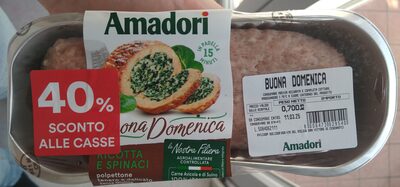
Amadori Happy Sunday Ricotta & Spinach comes in a 700 g pack. It is sold under the Amadori brand. On Mamori it sits under Frozen › Frozen Pasta & Rice › Frozen Ready Meals. Its label lists 41 ingredients.
Amadori Happy Sunday Ricotta & Spinach at a glance
Amadori Happy Sunday Ricotta & Spinach carries the Gluten Free, Crustaceans Free, Fish Free, Peanut Free, Soy Free, Tree Nut Free, Celery Free, Sesame Free, Sulfite Free, Lupin Free, Mollusks Free, Barley Free, Beef Free, Corn Free, Emulsifier Free, Gelatin Free, Latex Free, No Added Sugars, Oats Free, Rye Free and Wheat Free badges. Nutrition-wise, it's High Protein, Low Carbs, Low Sugars, High Salt/Sodium, Medium in Fiber, Medium in Calories and Medium Saturated Fat. Worth knowing: it's marked Non-Vegan, Non-Vegetarian, Non-Pescatarian, Non-Low FODMAP, Non-Vegan + Dairy, Non-Vegan + Eggs, Contains Egg, Contains Dairy, Contains Additives, Contains Artificial Flavourings, Contains Citrus Fruit, Contains Fructose, Lactose, Contains Pork, Contains Poultry, Contains Rice and Contains Seed.
Diet and allergens
Not suitable for vegan, vegetarian or pescatarian diets.
Contains eggs and milk.
Free from gluten, crustaceans, fish, peanuts, soy, tree nuts, celery, sesame, sulphites, lupin and molluscs.
May contain: mustard.
Based on Mamori's check of the ingredients on the label. Recipes change, so always read the pack if you have an allergy or intolerance.
Size: 700 g
Last updated 2 November 2026
Ingredients
turkey and chicken meat, water, spinach, pork meat, ricotta, whey, cream, salt, breading mix, potato starch, rice flour, potato flakes, olive oil, yeast, salt, leavening agent: sodium bicarbonate, thickener: guar gum, potato starch, iodized salt, salt, potassium iodate, potato flakes, vegetable fibers, lemon, lime, bamboo, parsley, skimmed milk powder, dehydrated egg, yeast extract, spices, dehydrated onion, sunflower oil, butter, milk proteins, flavors, natural flavor, salt, dehydrated garlic, acidity regulator: sodium diacetate, citric acid, antioxidant: sodium ascorbate
Additives & flavourings
Additives
- E500: Sodium Carbonates: (I) Sodium Carbonate (Ii) Sodium Bicarbonate (Sodium Hydrogen Carbonate) (Iii) Sodium Sesquicarbonate (Acidity Regulator): Generally safe
Sodium carbonates (E500) are a group of sodium salts, including sodium carbonate, sodium bicarbonate and sodium sesquicarbonate. The best-known is sodium bicarbonate, also called bicarbonate of soda.
They are used to control acidity, help baked goods rise by releasing carbon dioxide, and reduce clumping in some powdered foods. They can be found in baking powders, biscuits, cakes, self-raising flour, cocoa mixes and other dry food mixes.
E500 is generally considered safe. It is allowed in food in the EU after safety assessment, and the sources checked do not raise concerns at normal food amounts.
- E412: Guar Gum (Thickener): Generally safe
Guar gum (E412) is a thickening fibre made from the seeds of the guar plant, a type of legume. It is a natural polysaccharide, meaning a long-chain carbohydrate that absorbs water easily.
It is used to thicken, stabilise or improve texture in foods such as sauces, dressings, dairy products, ice cream, gluten-free baked goods and processed foods. It can also help stop ingredients from separating.
Guar gum is generally considered safe at normal food amounts. It is allowed in food in the EU after safety assessment, and the sources checked raise no concern for typical use.
- E917: Potassium Iodate: Generally safe
Potassium iodate, sometimes listed as E917, is an iodine-containing mineral salt. It is not treated as a food additive under EU law, but as a permitted source of iodine that may be added to foods.
It can be used to add iodine for nutritional purposes, for example in fortified foods or iodised salt, rather than to glaze, sweeten or preserve food.
It is generally considered safe when used as an approved iodine source in foods. Its EU status reflects that it is regulated as a nutrient source, not as a food additive.
- E631: Disodium Inosinate: Generally safe
Disodium inosinate, or E631, is a flavour enhancer. It is the sodium salt of inosinic acid, a substance related to naturally occurring compounds found in some foods. It can be made from animal or microbial sources, so it may not always be suitable for vegetarian or vegan diets.
It is used to boost savoury, “umami” flavours, often together with glutamates such as MSG. It may be found in snack foods, seasoning mixes, instant noodles, soups, sauces and processed savoury foods.
It is allowed in food in the EU after safety assessment, and is generally considered safe at normal amounts used in foods. The sources checked raise no specific concern for typical dietary exposure.
- E301: Sodium Ascorbate: Generally safe
Sodium ascorbate (E301) is the sodium salt of ascorbic acid, better known as vitamin C. It is a water-soluble substance used as an antioxidant and acidity regulator.
In food, it helps slow oxidation, which can prevent browning and flavour changes. It is used in a range of foods where antioxidant protection is needed, such as processed meats, preserved fruit, drinks and bakery products.
It is generally considered safe. It is allowed in food in the EU after safety assessment, and EFSA’s review raised no concern at normal dietary amounts.
Flavourings
- flavors: Flavouring (Regulation (EC) No 1334/2008 on flavourings, Article 16).
- natural flavor: Natural flavouring (Regulation (EC) No 1334/2008 on flavourings, Article 16).
Questions and answers
Is Amadori Happy Sunday Ricotta & Spinach vegan?
No. It contains eggs and milk, so it is not suitable for a vegan diet.
Is Amadori Happy Sunday Ricotta & Spinach vegetarian?
No. It is not suitable for a vegetarian diet.
Is Amadori Happy Sunday Ricotta & Spinach suitable for a pescatarian diet?
No. It is not suitable for a pescatarian diet.
Is Amadori Happy Sunday Ricotta & Spinach suitable for a Low FODMAP diet?
No. It is not suitable for a Low FODMAP diet.
Is Amadori Happy Sunday Ricotta & Spinach suitable for a Vegan + Dairy diet?
No. It is not suitable for a Vegan + Dairy diet.
Is Amadori Happy Sunday Ricotta & Spinach suitable for a Vegan + Eggs diet?
No. It is not suitable for a Vegan + Eggs diet.
Is Amadori Happy Sunday Ricotta & Spinach gluten-free?
Yes. Its ingredients include no gluten, and its label gives no gluten warning.
Does Amadori Happy Sunday Ricotta & Spinach contain milk?
Yes. It contains milk.
Is Amadori Happy Sunday Ricotta & Spinach nut-free?
Yes. Its ingredients include no peanuts or tree nuts, and its label gives no nut warning.
Does Amadori Happy Sunday Ricotta & Spinach contain eggs?
Yes. It contains eggs.
Which allergens does Amadori Happy Sunday Ricotta & Spinach contain?
It contains eggs and milk. Its label also says it may contain: mustard.
More in Frozen Ready Meals
- Vegan no beef pasties
- Chef Select Paella
- Maypole Beef & Pie
- Maypole Traditional Timpana
- Cassegrain Ratatouille Cooked Provençal Style
- Pukka Pies Export All Steak Pie
- Happy Boy Wonton pastry
- Waistnot Chicken Masala With Rice
- Waistnot Chicken Biryani With Rice
- Waistnot Beef Biryani With Rice
- Findus Creamy Pumpkin and Carrots
- Findus Creamy Protein