
Grenade Whey protein
On the pack: Whey protine
Grenade
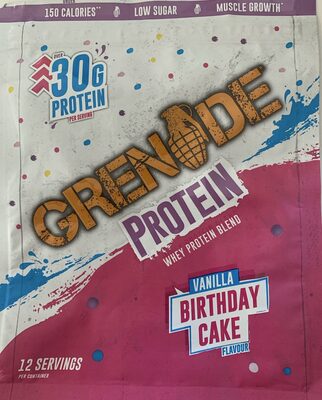
Grenade Whey protein is listed on Mamori. It is sold under the Grenade brand. On Mamori it sits under Additives › Protein Additives › Whey Protein. Its label lists 18 ingredients.
Grenade Whey protein at a glance
Grenade Whey protein fits Vegetarian and Pescatarian diets. It also carries the Peanut Free, Tree Nut Free, Celery Free, Sesame Free, Lupin Free, Beef Free, Citrus Fruit Free, Fructose Free, Gelatin Free, Latex Free, No Added Sugars, Oats Free, Pork Free and Rice Free badges. Nutrition-wise, it's High Protein, Low Carbs, Low Saturated Fat, Low Sugars, Low Fiber, Medium in Calories and Medium Salt/Sodium. Worth knowing: it's marked Non-Vegan, Non-Low FODMAP, Non-Vegan + Dairy, Non-Vegan + Eggs, Contains Dairy, Contains Additives, Contains Artificial Flavourings, Contains Barley, Contains Corn, Contains Emulsifier, Lactose, Contains Poultry, Contains Rye, Contains Seed and Contains Wheat.
Diet and allergens
Suitable for vegetarian and pescatarian diets.
Not suitable for a vegan diet.
Contains milk.
Free from peanuts, tree nuts, celery, sesame and lupin.
May contain: milk, gluten, eggs, crustaceans, fish, soy, sulfites, mustard.
Based on Mamori's check of the ingredients on the label. Recipes change, so always read the pack if you have an allergy or intolerance.
Last updated 30 October 2026
Ingredients
whey protein concentrate, whey protein isolate, low-fat cocoa powder, flavor, sodium chloride, thickening agent:xanthan gum, cocoa extract, sweeteners, acesulfame K, sucralose, digestive enzyme blend, amylase, protease, cellulase, lipase, lactase:DigeZyme®, emulsifier:lecithin, colorant:beetroot red
Additives & flavourings
Additives
- E415: Xanthan Gum (Thickener): Generally safe
Xanthan gum (E415) is a thickening and stabilising gum made by fermenting sugars with the bacterium Xanthomonas campestris, then purifying and drying the resulting substance.
It helps foods hold water, thicken, and keep ingredients evenly mixed. It is often used in sauces, dressings, desserts, bakery products, gluten-free foods, and drinks where a smooth or stable texture is needed.
Xanthan gum is generally considered safe. It is allowed in food in the EU after EFSA assessment, and the sources checked do not raise concerns at normal amounts used in foods.
- E950: Acesulfame K: Generally safe
Acesulfame K, also called acesulfame potassium or E950, is an artificial sweetener. It is a potassium salt of a synthetic sweet-tasting compound and is much sweeter than sugar, so only small amounts are used.
It is used to sweeten foods and drinks without adding much energy. It is often found in sugar-free or reduced-sugar soft drinks, desserts, chewing gum, tabletop sweeteners and some special dietary foods.
It is generally considered safe at normal amounts. It is authorised for use in the EU after safety assessment, and the sources checked raise no concern when it is used within permitted limits.
- E955: Sucralose (Trichlorogalactosucrose): Generally safe
Sucralose (E955), also called trichlorogalactosucrose, is an artificial high-intensity sweetener. It is made by chemically modifying sugar, which makes it taste very sweet while adding little or no energy in the small amounts used.
It is used to sweeten foods and drinks without using much sugar. You may find it in low-sugar or sugar-free drinks, desserts, yoghurts, chewing gum, tabletop sweeteners, and some special diet foods.
Sucralose is generally considered safe at normal amounts. It is authorised for use in the EU after safety assessment, and the sources checked raise no concern for typical food use.
- E1100: Amylase: Generally safe
Amylase, sometimes linked with E1100, is a food enzyme rather than a food additive under EU law. It is a protein enzyme that breaks down starch into smaller sugars, and may be obtained from plants, animals or microorganisms.
It is used to help process starchy foods. Typical uses include bread-making, brewing, and the production of syrups or other foods where starch needs to be broken down.
It is generally considered safe when used as intended. In the EU, amylase is regulated under the separate rules for food enzymes, not as a listed food additive.
- E1101: Proteases ((I)Protease, (Ii)Papain, (Iii)Bromelain, (Iv)Ficin): Generally safe
Proteases, sometimes listed as E1101, are food enzymes that break down proteins. They include protease, papain from papaya, bromelain from pineapple, and ficin from figs.
They are used to change protein texture, such as tenderising meat, improving dough handling, clarifying some drinks, or helping produce protein hydrolysates and flavour ingredients.
They are generally considered safe when used as intended. In the EU, E1101 proteases are not treated as food additives; they are regulated separately as food enzymes under their own rules.
- E1104: Lipases: Generally safe
Lipases, often listed as E1104, are food enzymes that break down fats. They can be made by microbes, plants or animal tissues, so some sources may not be suitable for vegetarian or vegan diets.
They are used to change fat-related flavours and textures, for example in cheese making, bakery products, flavour production and processing of fats and oils. Their role is technological: helping reactions happen during processing.
They are generally considered safe when used as intended. In the EU, lipases are not treated as food additives; they are regulated separately as food enzymes under their own rules.
- E322: Lecithins: Generally safe
Lecithins (E322) are a group of natural fatty substances found in plants and animals. Food-grade lecithin is usually made from soya, sunflower, rapeseed or egg, and in some cases may be animal derived.
They are mainly used as emulsifiers, helping oil and water mix and keeping textures smooth. They are found in foods such as chocolate, spreads, baked goods, sauces, margarines and instant powders.
Lecithins are generally considered safe at normal food amounts and are allowed in the EU after safety assessment. People with relevant allergies should note the source, especially soya or egg.
Flavourings
- flavor: Flavouring (Regulation (EC) No 1334/2008 on flavourings, Article 16).
Questions and answers
Is Grenade Whey protein vegan?
No. It contains milk, so it is not suitable for a vegan diet.
Is Grenade Whey protein vegetarian?
Yes. It is suitable for a vegetarian diet.
Is Grenade Whey protein suitable for a pescatarian diet?
Yes. It is suitable for a pescatarian diet.
Is Grenade Whey protein suitable for a Low FODMAP diet?
No. It is not suitable for a Low FODMAP diet.
Is Grenade Whey protein suitable for a Vegan + Dairy diet?
No. It is not suitable for a Vegan + Dairy diet.
Is Grenade Whey protein suitable for a Vegan + Eggs diet?
No. It is not suitable for a Vegan + Eggs diet.
Does Grenade Whey protein contain milk?
Yes. It contains milk.
Is Grenade Whey protein nut-free?
Yes. Its ingredients include no peanuts or tree nuts, and its label gives no nut warning.
Which allergens does Grenade Whey protein contain?
It contains milk. Its label also says it may contain: milk, gluten, eggs, crustaceans, fish, soy, sulfites, mustard.
More in Whey Protein
- IronMaxx Whey Dubai Chocolate
- Optimum nutrition 100% Gold Standard Whey French Vanilla Crème
- Applied Nutrition Critical Whey Advance Protein
- Lidl Whey Protein - Chocolate Flavour
- MYPROTEIN My Protein Impact Whey Isolate Vanilla - 1000g
- Naughty Boy Whey Protein Vanilla Ice Cream Flavour
- Olimp Whey protein complex
- Vplab Gold whey
- Applied Nutrition Critical Whey Advanced Protein
- Prozis Real whey 100% whey protein
- IronMaxx 100% Whey Protein
- Ghost Whey Protein