
Usn Bcaa Power Punch Watermelon 400 g
Usn
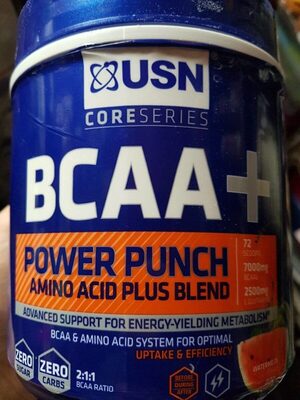
Usn Bcaa Power Punch Watermelon comes in a 400 g pack. It is sold under the Usn brand. On Mamori it sits under Additives › Nutrient Additives › Nutritive. Its label lists 11 ingredients.
Usn Bcaa Power Punch Watermelon at a glance
Usn Bcaa Power Punch Watermelon fits Vegan, Vegetarian and Pescatarian diets. It also carries the Gluten Free, Egg Free, Celery Free, Mustard Free, Sesame Free, Lupin Free, Barley Free, Beef Free, Citrus Fruit Free, Corn Free, Fructose Free, Gelatin Free, Latex Free, No Added Sugars, Oats Free, Pork Free, Poultry Free, Rice Free, Rye Free and Wheat Free badges. Nutrition-wise, it's High Protein, Low Salt/Sodium, Low Saturated Fat, Low Sugars, Low Fiber, Medium in Calories and Medium Carbs. Worth knowing: it's marked Non-Low FODMAP, Non-Vegan + Dairy, Non-Vegan + Eggs, Contains Additives, Contains Artificial Flavourings, Contains Emulsifier, Lactose and Contains Seed.
Diet and allergens
Suitable for vegan, vegetarian and pescatarian diets.
Free from gluten, eggs, celery, mustard, sesame and lupin.
May contain: soy, cows milk, tree nuts, PEANUTS, Crustaceans.
Based on Mamori's check of the ingredients on the label. Recipes change, so always read the pack if you have an allergy or intolerance.
Size: 400 g
Last updated 17 August 2026
Ingredients
L-Leucine, L-Citrulline malate, L-Glutamine, L-Isoleucine, L-Valine, flavouring, Citric Acid, Sucralose, Colour: E124, Pyridoxine HCl, BioPerine
Additives & flavourings
Additives
- E641: L-Leucine: Generally safe
L-leucine (E641) is an essential amino acid, one of the building blocks of protein. It occurs naturally in many protein-rich foods and can also be made for use as a food additive.
In food, it is used as a nutrient and protein-related additive, and may be added to foods where amino acids are used to adjust nutritional content or formulation. Its use is more about nutrition than flavour, colour, or preservation.
It is generally considered safe at normal food amounts. E641 is allowed in food in the EU after safety assessment, and the checked sources raise no concern for typical use.
- E330: Citric Acid: Generally safe
Citric acid (E330) is a natural organic acid found in citrus fruits and many other plants. The citric acid used in food is usually made by fermentation of sugars using micro-organisms.
It is used as an acidity regulator and antioxidant. It helps give a sharp, sour taste, control pH, and slow colour or flavour changes. It is common in soft drinks, sweets, jams, sauces, canned foods, and many processed foods.
Citric acid is generally considered safe at normal food levels. It is allowed in food in the EU after safety assessment, and the sources checked raise no concern for typical dietary amounts.
- E955: Sucralose (Trichlorogalactosucrose): Generally safe
Sucralose (E955), also called trichlorogalactosucrose, is an artificial high-intensity sweetener. It is made by chemically modifying sugar, which makes it taste very sweet while adding little or no energy in the small amounts used.
It is used to sweeten foods and drinks without using much sugar. You may find it in low-sugar or sugar-free drinks, desserts, yoghurts, chewing gum, tabletop sweeteners, and some special diet foods.
Sucralose is generally considered safe at normal amounts. It is authorised for use in the EU after safety assessment, and the sources checked raise no concern for typical food use.
- E124: Ponceau 4R (Cochineal Red A, Brilliant Scarlet 4R): Some concerns
Ponceau 4R, also called Cochineal Red A or E124, is a synthetic red azo dye. It is not the same as natural cochineal, despite the similar name.
It is used to give foods and drinks a bright red or pink colour. It may be found in sweets, soft drinks, desserts, ice lollies, jams, sauces and other coloured processed foods.
It is allowed in the EU, but some concerns have been raised. Foods containing E124 must carry a warning that it “may have an adverse effect on activity and attention in children”.
Flavourings
- flavouring: Flavouring (Regulation (EC) No 1334/2008 on flavourings, Article 16).
Questions and answers
Is Usn Bcaa Power Punch Watermelon vegan?
Yes. It is suitable for a vegan diet.
Is Usn Bcaa Power Punch Watermelon vegetarian?
Yes. It is suitable for a vegetarian diet.
Is Usn Bcaa Power Punch Watermelon suitable for a pescatarian diet?
Yes. It is suitable for a pescatarian diet.
Is Usn Bcaa Power Punch Watermelon suitable for a Low FODMAP diet?
No. It is not suitable for a Low FODMAP diet.
Is Usn Bcaa Power Punch Watermelon suitable for a Vegan + Dairy diet?
No. It is not suitable for a Vegan + Dairy diet.
Is Usn Bcaa Power Punch Watermelon suitable for a Vegan + Eggs diet?
No. It is not suitable for a Vegan + Eggs diet.
Is Usn Bcaa Power Punch Watermelon gluten-free?
Yes. Its ingredients include no gluten, and its label gives no gluten warning.
Does Usn Bcaa Power Punch Watermelon contain eggs?
No. Its ingredients include no eggs, and its label gives no egg warning.
Does Usn Bcaa Power Punch Watermelon carry an allergy warning?
Yes. Its label says it may contain: soy, cows milk, tree nuts, PEANUTS, Crustaceans.
More in Nutritive
- Namedsport Magnesium Liquid
- Qnt Creatine Monohydrate
- Powerbar Orange Isotonic Sports Drink
- Optimum Nutrition 330 g
- Optimum nutrition Emino Energy Pineapple Flavour
- Optimum nutrition Bcaa Apple&pear
- Optimum nutrition Amino Energy Lemon & Lime
- Optimum Nutrition Creatine Unflavored
- Olimp Iso Plus + L Carnitine Lemon Flavour
- Naturya Organic Chlorella Powder
- Diet-food Pure Collagen
- Diet Foods Bio Hazelnut Cacao Crunchy Cream