
Senza Peccato Tiramisu con savoiardi 125 g
Senza Peccato
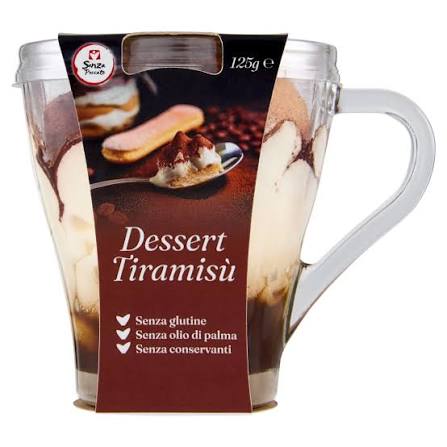
Senza Peccato Tiramisu con savoiardi comes in a 125 g pack. It is sold under the Senza Peccato brand. On Mamori it sits under Snacks › Desserts › Tiramisu. Its label lists 37 ingredients.
Senza Peccato Tiramisu con savoiardi at a glance
Senza Peccato Tiramisu con savoiardi carries the Gluten Free, Crustaceans Free, Fish Free, Celery Free, Mustard Free, Sesame Free, Sulfite Free, Lupin Free, Mollusks Free, Barley Free, Citrus Fruit Free, Latex Free, Oats Free, Pork Free, Poultry Free, Rye Free and Wheat Free badges. Nutrition-wise, it's Low Fiber, Low Protein, High Saturated Fat, Medium in Calories, Medium Carbs, Medium Salt/Sodium and Medium in Sugars. Worth knowing: it's marked Non-Vegan, Non-Vegetarian, Non-Pescatarian, Non-Low FODMAP, Non-Vegan + Dairy, Non-Vegan + Eggs, Contains Egg, Contains Dairy, Contains Additives, Contains Artificial Flavourings, Contains Beef, Contains Corn, Contains Emulsifier, Contains Fructose, Contains Gelatin, Lactose, Contains Added Sugars, Contains Rice and Contains Seed.
Diet and allergens
Not suitable for vegan, vegetarian or pescatarian diets.
Contains eggs and milk.
Free from gluten, crustaceans, fish, celery, mustard, sesame, sulphites, lupin and molluscs.
May contain: soy, hazelnuts, almonds, pistachios, peanuts.
Based on Mamori's check of the ingredients on the label. Recipes change, so always read the pack if you have an allergy or intolerance.
Size: 125 g
Last updated 13 November 2026
Ingredients
reconstituted powdered milk, vegetable margarine, coconut fat, sunflower seed oil, water, mascarpone semi-finished product, cream, whey, salt, sugar, egg white, ladyfinger biscuit, sugar, rice flour, corn starch, eggs, water, humectant: glycerol, raising agent: ammonium bicarbonate, thickener: xanthan gum, guar gum, salt, stabilizer: glycerol, corn maltodextrin, corn starch, cocoa, vanilla flavor, eggs, emulsifiers: mono- and diglycerides of fatty acids, rice flour, thickeners: carrageenan, animal gelatin: bovine, instant coffee, salt, raising agents: sodium pyrophosphate, sodium bicarbonate, pea fiber, flavors
Additives & flavourings
Additives
- E422: Glycerol (Emulsifier): Generally safe
Glycerol, or E422, is a clear, sweet-tasting liquid also known as glycerine. It is a type of sugar alcohol and can be made from vegetable oils, animal fats, or produced synthetically.
In food, it helps keep moisture in, thickens texture, stabilises mixtures, and can help emulsions stay smooth. It is used in a range of foods where softness, moisture retention, or smooth texture is needed, such as confectionery, baked goods, icings, and some drinks.
Glycerol is generally considered safe at normal food amounts. It is allowed in food in the EU after safety assessment, and the sources checked raise no concern for typical use.
- E503: Ammonium Carbonates: (I) Ammonium Carbonate (Ii) Ammonium Bicarbonate (Ammonium Hydrogen Carbonate): Generally safe
Ammonium carbonates (E503) are raising agents made up of ammonium carbonate and ammonium bicarbonate, also called ammonium hydrogen carbonate. They are simple inorganic salts that release gas when heated.
In food, E503 helps doughs and batters rise, especially in baked goods such as biscuits, crackers and some traditional baked products. It can also act as an acidity regulator or anti-caking agent in some uses.
It is generally considered safe at normal food levels. E503 is allowed in food in the EU after safety assessment, and the sources checked raise no concern for typical amounts used in foods.
- E415: Xanthan Gum (Thickener): Generally safe
Xanthan gum (E415) is a thickening and stabilising gum made by fermenting sugars with the bacterium Xanthomonas campestris, then purifying and drying the resulting substance.
It helps foods hold water, thicken, and keep ingredients evenly mixed. It is often used in sauces, dressings, desserts, bakery products, gluten-free foods, and drinks where a smooth or stable texture is needed.
Xanthan gum is generally considered safe. It is allowed in food in the EU after EFSA assessment, and the sources checked do not raise concerns at normal amounts used in foods.
- E412: Guar Gum (Thickener): Generally safe
Guar gum (E412) is a thickening fibre made from the seeds of the guar plant, a type of legume. It is a natural polysaccharide, meaning a long-chain carbohydrate that absorbs water easily.
It is used to thicken, stabilise or improve texture in foods such as sauces, dressings, dairy products, ice cream, gluten-free baked goods and processed foods. It can also help stop ingredients from separating.
Guar gum is generally considered safe at normal food amounts. It is allowed in food in the EU after safety assessment, and the sources checked raise no concern for typical use.
- E471: Mono- And Diglycerides Of Fatty Acids (Glyceryl Monostearate, Glyceryl Distearate): Generally safe
Mono- and diglycerides of fatty acids, or E471, are emulsifiers made from glycerol and fatty acids. The fatty acids can come from vegetable oils or animal fats, so the source is not always clear unless stated by the producer.
They help oil and water mix, improve texture, and keep foods stable. They are often used in baked goods, spreads, desserts, ice cream, sauces, and processed foods where a smooth or consistent texture is needed.
E471 is generally considered safe. It is allowed in food in the EU after safety assessment, and the sources we check raise no concern at normal amounts.
- E407: Carrageenan (Thickener) (Stabiliser) (Gelling Agent): Some concerns
Carrageenan, or E407, is a thickening and gelling additive made from red seaweed. It is a large carbohydrate substance used to change the texture of foods.
It helps foods become thicker, creamier or more stable, and can also help gels form. It is often used in dairy desserts, flavoured milks, ice cream, plant-based drinks, sauces and processed meats.
It is allowed in food, but some concerns have been raised. EFSA found that people who eat a lot of foods containing carrageenan could go over the safe daily amount, so high intake is the main issue.
- E428: Gelatin: Generally safe
Gelatine, formerly known as E428, is a protein-based ingredient made by partially breaking down collagen, usually from animal skin, bones or connective tissue. It is not considered a food additive under EU law; edible gelatine is treated as a food ingredient.
It helps foods set, thicken, stabilise or give a smooth texture. It is commonly used in jelly sweets, desserts, marshmallows, yoghurts, meat products and some capsules or glazes.
It is generally considered safe for most people when used in food. The main point for shoppers is that it may be animal derived, so it may not be suitable for vegetarian, vegan or certain religious diets.
- E514: Sodium Sulfates (I) Sodium Sulfate (Ii) Sodium Bisulfate: Generally safe
Sodium sulphates (E514) are mineral salts of sulphuric acid, mainly sodium sulphate and sodium bisulphate. They are inorganic compounds used in small amounts in food.
They help control acidity and can also act as anti-caking agents, helping powders stay free-flowing. They may be used in foods where acidity control or dry powder handling is needed, such as some processed foods and powdered mixes.
E514 is generally considered safe at normal food-use levels. It is allowed in the EU after safety assessment, and the sources checked raise no concern for typical amounts in food.
Flavourings
- vanilla flavor: Flavouring (Regulation (EC) No 1334/2008 on flavourings, Article 16).
- flavors: Flavouring.
Questions and answers
Is Senza Peccato Tiramisu con savoiardi vegan?
No. It contains eggs and milk, so it is not suitable for a vegan diet.
Is Senza Peccato Tiramisu con savoiardi vegetarian?
No. It is not suitable for a vegetarian diet.
Is Senza Peccato Tiramisu con savoiardi suitable for a pescatarian diet?
No. It is not suitable for a pescatarian diet.
Is Senza Peccato Tiramisu con savoiardi suitable for a Low FODMAP diet?
No. It is not suitable for a Low FODMAP diet.
Is Senza Peccato Tiramisu con savoiardi suitable for a Vegan + Dairy diet?
No. It is not suitable for a Vegan + Dairy diet.
Is Senza Peccato Tiramisu con savoiardi suitable for a Vegan + Eggs diet?
No. It is not suitable for a Vegan + Eggs diet.
Is Senza Peccato Tiramisu con savoiardi gluten-free?
Yes. Its ingredients include no gluten, and its label gives no gluten warning.
Does Senza Peccato Tiramisu con savoiardi contain milk?
Yes. It contains milk.
Does Senza Peccato Tiramisu con savoiardi contain eggs?
Yes. It contains eggs.
Which allergens does Senza Peccato Tiramisu con savoiardi contain?
It contains eggs and milk. Its label also says it may contain: soy, hazelnuts, almonds, pistachios, peanuts.