
Sriracha Salad Cream 440 ml
On the pack: Sriracha Salatcreme
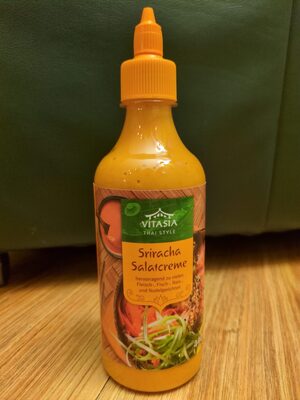
Sriracha Salad Cream comes in a 440 ml pack. On Mamori it sits under Groceries › Condiments › Special Sauce. Its label lists 19 ingredients.
Sriracha Salad Cream at a glance
Sriracha Salad Cream fits Vegan, Vegetarian and Pescatarian diets. It also carries the Egg Free, Dairy Free, Celery Free, Sulfite Free, Artificial Flavourings Free, Beef Free, Citrus Fruit Free, Emulsifier Free, Gelatin Free, Lactose Free, Latex Free, Oats Free, Pork Free, Poultry Free and Rice Free badges. Nutrition-wise, it's Low Fiber, Low Protein, High Carbs, High Salt/Sodium, High in Sugars, Medium in Calories and Medium Saturated Fat. Worth knowing: it's marked Non-Low FODMAP, Non-Vegan + Dairy, Non-Vegan + Eggs, Contains Soy, Contains Mustard, Contains Additives, Contains Barley, Contains Corn, Contains Fructose, Contains Added Sugars, Contains Rye, Contains Seed and Contains Wheat.
Diet and allergens
Suitable for vegan, vegetarian and pescatarian diets.
Contains soy and mustard.
Free from eggs, milk, celery and sulphites.
May contain: Fish, Mollusks, Peanuts, Sesame, Shellfish, Wheat, Barley.
Based on Mamori's check of the ingredients on the label. Recipes change, so always read the pack if you have an allergy or intolerance.
Size: 440 ml
Last updated 2 November 2026
Ingredients
Salad cream, water, soybean oil, sugar, spirit vinegar, modified starch, table salt, mustard seed, preservative: potassium sorbate, antioxidant: tertiary butylhydroquinone, Sugar, Salted red chili, red chili, table salt, Water, Garlic, Table salt, Modified starch, Acidity regulator: acetic acid
Additives
- E1401: Modified Starch ((Acid-Treated Starch) Stabiliser): Generally safe
Acid-treated starch, often labelled E1401 in some systems, is a modified starch. It is made by treating ordinary starch from plants such as maize, potato or wheat with acid to change how it behaves in food.
It helps thicken, stabilise or improve texture, especially where a smooth, consistent result is needed. Modified starches are used in foods such as sauces, soups, desserts, fillings and processed meals.
It is generally considered safe. Under EU law, acid-treated starch is not classed as a food additive; it is treated as a food ingredient instead.
- E202: Potassium Sorbate: Some concerns
Potassium sorbate (E202) is the potassium salt of sorbic acid. It is a preservative used to slow the growth of moulds and yeasts in food and drink.
It is often used in products where spoilage by yeasts or moulds is a concern, such as sauces, bakery fillings, cheese products, fruit preparations, drinks and some processed foods.
It is allowed in food, but some concerns have been raised. EFSA found that people who eat a lot of foods containing sorbates could go over the safe daily amount, so overall exposure is the main issue.
- E319: Tertiary-Butyl Hydroquinone (TBHQ): Generally safe
Tertiary-butyl hydroquinone, or TBHQ (E319), is a synthetic antioxidant. It is related to hydroquinone and is made for use in very small amounts to help protect fats and oils.
It slows rancidity and helps preserve flavour, colour and shelf life in fatty foods. It may be used in products such as vegetable oils, frying fats, snacks, dried mixes and other foods where oxidation of fats is a concern.
TBHQ is generally considered safe at permitted levels. It is allowed in food in the EU after EFSA safety assessment, and the reviewed sources raise no concern at normal amounts.
- E260: Acetic Acid (Preservative): Generally safe
Acetic acid (E260) is the main acid in vinegar. It is a simple organic acid, usually made by fermentation of sugars or alcohol, or produced industrially to food-grade standards.
It is used as a preservative and acidity regulator. It helps give foods a sharp, sour taste and can slow the growth of some microbes. It is found in vinegar, pickles, sauces, dressings, marinades and some preserved foods.
It is generally considered safe at normal food amounts. It is authorised for use in foods in the EU after safety assessment, and the sources checked raise no specific concern for typical dietary exposure.
Questions and answers
Is Sriracha Salad Cream vegan?
Yes. It is suitable for a vegan diet.
Is Sriracha Salad Cream vegetarian?
Yes. It is suitable for a vegetarian diet.
Is Sriracha Salad Cream suitable for a pescatarian diet?
Yes. It is suitable for a pescatarian diet.
Is Sriracha Salad Cream suitable for a Low FODMAP diet?
No. It is not suitable for a Low FODMAP diet.
Is Sriracha Salad Cream suitable for a Vegan + Dairy diet?
No. It is not suitable for a Vegan + Dairy diet.
Is Sriracha Salad Cream suitable for a Vegan + Eggs diet?
No. It is not suitable for a Vegan + Eggs diet.
Does Sriracha Salad Cream contain milk?
No. Its ingredients include no milk, and its label gives no milk warning.
Does Sriracha Salad Cream contain eggs?
No. Its ingredients include no eggs, and its label gives no egg warning.
Which allergens does Sriracha Salad Cream contain?
It contains soy and mustard. Its label also says it may contain: Fish, Mollusks, Peanuts, Sesame, Shellfish, Wheat, Barley.
More in Special Sauce
- Old el Passo Chunky Salsa médium
- Lee Kum Kee Sweet and Sour Sauce
- Ken's Steak House Chunky Blue Cheese
- Supervalu Gravy Mix
- Lee Kum Kee Hoisin Sauce
- LA CUISINE D'AUTREFOIS Sichuan spicy chili sauce
- ALDI Applesauce
- Heinz Curry Mango Sauce
- Heinz Turkish style garlic sauce
- Rabeko Products Garlic Sauce Zero
- Nando's Perinaise Lemon Pepper
- Nando's Medium Peri Peri Sauce