
schwartz Hollandaise Sauce 25 g
schwartz
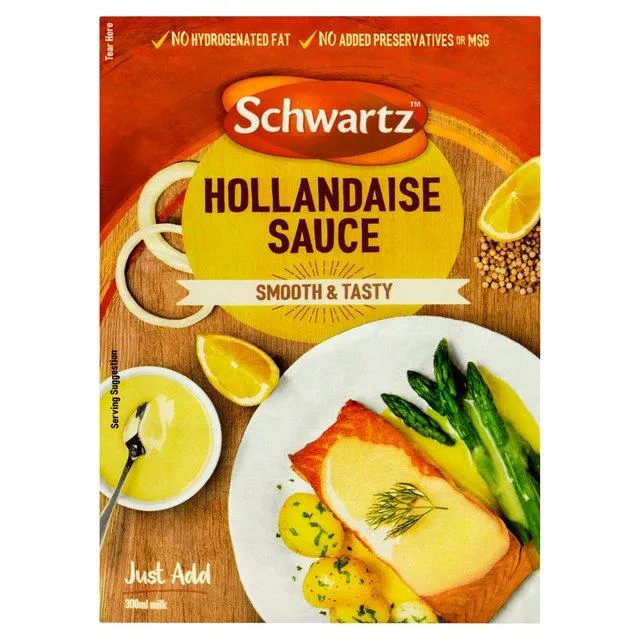
schwartz Hollandaise Sauce comes in a 25 g pack. It is sold under the schwartz brand. On Mamori it sits under Groceries › Panna & Besciamella › Bechamel Sauce. Its label lists 29 ingredients.
schwartz Hollandaise Sauce at a glance
schwartz Hollandaise Sauce fits Vegetarian and Pescatarian diets. It also carries the Crustaceans Free, Fish Free, Peanut Free, Soy Free, Tree Nut Free, Celery Free, Sesame Free, Sulfite Free, Mollusks Free, Beef Free, Fructose Free, Gelatin Free, Latex Free, Oats Free and Pork Free badges. Nutrition-wise, it's Low Sugars, High Calorie, High Carbs, High Salt/Sodium, High Saturated Fat, Medium in Fiber and Medium in Protein. Worth knowing: it's marked Non-Vegan, Non-Low FODMAP, Non-Vegan + Dairy, Non-Vegan + Eggs, Contains Gluten, Contains Egg, Contains Dairy, Contains Mustard, Contains Additives, Contains Artificial Flavourings, Contains Barley, Contains Citrus Fruit, Contains Corn, Contains Emulsifier, Lactose, Contains Added Sugars, Contains Poultry, Contains Rice, Contains Rye, Contains Seed and Contains Wheat.
Diet and allergens
Suitable for vegetarian and pescatarian diets.
Not suitable for a vegan diet.
Contains gluten, eggs, milk and mustard.
Free from crustaceans, fish, peanuts, soy, tree nuts, celery, sesame, sulphites and molluscs.
Based on Mamori's check of the ingredients on the label. Recipes change, so always read the pack if you have an allergy or intolerance.
Size: 25 g
Last updated 2 November 2026
Ingredients
modified starch, Wheat Flour, Calcium, Iron, Vitamin B3, Vitamin B1, Skimmed Milk Powder, Maltodextrin, Fat Powder, Sunflower oil, Lactose, Milk protein, Cream powder, salt, Flavouring, barley, Wheat, Natural Lemon Flavourings, Citric Acid, Butter Powder, Butter, Maltodextrin, milk proteins, mustard flour, Onion Powder, Egg Powder, Whey powder, Carotenes, White Pepper
Additives & flavourings
Additives
- E1401: Modified Starch ((Acid-Treated Starch) Stabiliser): Generally safe
Acid-treated starch, often labelled E1401 in some systems, is a modified starch. It is made by treating ordinary starch from plants such as maize, potato or wheat with acid to change how it behaves in food.
It helps thicken, stabilise or improve texture, especially where a smooth, consistent result is needed. Modified starches are used in foods such as sauces, soups, desserts, fillings and processed meals.
It is generally considered safe. Under EU law, acid-treated starch is not classed as a food additive; it is treated as a food ingredient instead.
- E330: Citric Acid: Generally safe
Citric acid (E330) is a natural organic acid found in citrus fruits and many other plants. The citric acid used in food is usually made by fermentation of sugars using micro-organisms.
It is used as an acidity regulator and antioxidant. It helps give a sharp, sour taste, control pH, and slow colour or flavour changes. It is common in soft drinks, sweets, jams, sauces, canned foods, and many processed foods.
Citric acid is generally considered safe at normal food levels. It is allowed in food in the EU after safety assessment, and the sources checked raise no concern for typical dietary amounts.
- E160a: Carotenes: Generally safe
Carotenes (E160a) are orange-yellow colourants, including alpha-carotene, beta-carotene and gamma-carotene. They are pigments found naturally in plants such as carrots and leafy greens, and can also be made synthetically or obtained from natural sources. Some forms may be animal derived.
They are used to add or restore yellow to orange colour in foods. They may be found in products such as margarines, dairy products, desserts, sauces, drinks and confectionery.
E160a is allowed in food in the EU after safety assessment. It is generally considered safe at normal food amounts, and the sources checked raise no concern for typical use.
Flavourings
- Flavouring: Flavouring (Regulation (EC) No 1334/2008 on flavourings, Article 16).
- Natural Lemon Flavourings: Natural lemon flavouring (Regulation (EC) No 1334/2008 on flavourings, Article 16).
Questions and answers
Is schwartz Hollandaise Sauce vegan?
No. It contains eggs and milk, so it is not suitable for a vegan diet.
Is schwartz Hollandaise Sauce vegetarian?
Yes. It is suitable for a vegetarian diet.
Is schwartz Hollandaise Sauce suitable for a pescatarian diet?
Yes. It is suitable for a pescatarian diet.
Is schwartz Hollandaise Sauce suitable for a Low FODMAP diet?
No. It is not suitable for a Low FODMAP diet.
Is schwartz Hollandaise Sauce suitable for a Vegan + Dairy diet?
No. It is not suitable for a Vegan + Dairy diet.
Is schwartz Hollandaise Sauce suitable for a Vegan + Eggs diet?
No. It is not suitable for a Vegan + Eggs diet.
Is schwartz Hollandaise Sauce gluten-free?
No. It contains gluten.
Does schwartz Hollandaise Sauce contain milk?
Yes. It contains milk.
Is schwartz Hollandaise Sauce nut-free?
Yes. Its ingredients include no peanuts or tree nuts, and its label gives no nut warning.
Does schwartz Hollandaise Sauce contain eggs?
Yes. It contains eggs.
Which allergens does schwartz Hollandaise Sauce contain?
It contains gluten, eggs, milk and mustard.
More in Bechamel Sauce
- Virgilio Cooking Cream UHT
- Virgilio Cooking Cream UHT
- Virgilio Uht Béchamel
- Virgilio Uht Béchamel
- vemondo Organic Oat Cream
- Vitariz Bio Organic Vegetable Rice Béchamel
- Carrefour Béchamel
- Sacla Vegan Cheese Sauce
- Trevalli Béchamel
- Sacla Vegan Bechamel White Sauce
- Chef Parmalat Lactose Free Bechamel
- Ecomil Bechamel Sauce