
General Mills Puffs Treats 192 g
General Mills, reese's
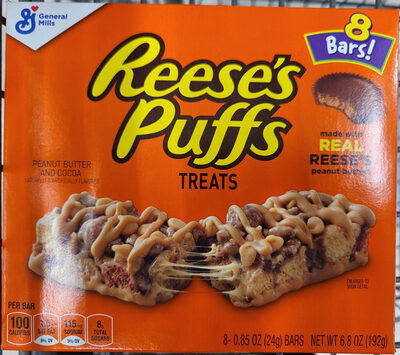
General Mills Puffs Treats comes in a 192 g pack. It is sold under the General Mills and reese's brands. On Mamori it sits under Confectionery › Chocolates › Reeses. Its label lists 69 ingredients.
General Mills Puffs Treats at a glance
General Mills Puffs Treats carries the Crustaceans Free, Egg Free, Fish Free, Tree Nut Free, Celery Free, Mustard Free, Sesame Free, Lupin Free, Mollusks Free, Citrus Fruit Free, Latex Free, Oats Free and Poultry Free badges. Nutrition-wise, it's Low Salt/Sodium, High Calorie, High Carbs, High Saturated Fat, High in Sugars, Medium in Fiber and Medium in Protein. Worth knowing: it's marked Non-Vegan, Non-Vegetarian, Non-Pescatarian, Non-Low FODMAP, Non-Vegan + Dairy, Non-Vegan + Eggs, Contains Peanut, Contains Soy, Contains Dairy, Contains Additives, Contains Artificial Flavourings, Contains Barley, Contains Beef, Contains Corn, Contains Emulsifier, Contains Fructose, Contains Gelatin, Lactose, Contains Added Sugars, Contains Pork, Contains Rice, Contains Rye, Contains Seed and Contains Wheat.
Diet and allergens
Not suitable for vegan, vegetarian or pescatarian diets.
Contains peanuts, soy and milk.
Free from crustaceans, eggs, fish, tree nuts, celery, mustard, sesame, lupin and molluscs.
May contain: gluten.
Based on Mamori's check of the ingredients on the label. Recipes change, so always read the pack if you have an allergy or intolerance.
Size: 192 g
Last updated 2 November 2026
Ingredients
whole grain corn, sugar, REESE'S peanut butter, peanuts, sugar, monoglycerides, peanut oil, salt, molasses, corn starch, dextrose, corn meal, corn syrup, canola oil, sunflower oil, salt, HERSHEY'S cocoa, caramel color, trisodium phosphate, natural flavor, artificial flavor, vitamin E: mixed tocopherols, tricalcium phosphate, calcium carbonate, vitamin C: sodium ascorbate, iron, zinc, niacinamide: Vitamin B3, vitamin B6: pyridoxine hydrochloride, vitamin B1: thiamin mononitrate, vitamin A: palmitate, vitamin B2: riboflavin, folic acid, vitamin B12, vitamin D3, chocolate-flavored crisp rice, rice flour, cocoa processed with alkali, sugar, malt extract, salt, caramel color, mini REESE'S peanut butter chips, partially defatted peanuts, sugar, hydrogenated vegetable oil, palm kernel oil, soybean oil, corn syrup solids, dextrose, reduced protein whey, salt, palm kernel oil, artificial flavor, soy lecithin, vegetable oil, palm kernel oil, palm oil, canola oil, peanut flour, high fructose corn syrup, fructose, vegetable glycerin, peanuts, sorbitol, nonfat dry milk, corn starch, gelatin, soy lecithin
Additives & flavourings
Additives
- E471: Mono- And Diglycerides Of Fatty Acids (Glyceryl Monostearate, Glyceryl Distearate): Generally safe
Mono- and diglycerides of fatty acids, or E471, are emulsifiers made from glycerol and fatty acids. The fatty acids can come from vegetable oils or animal fats, so the source is not always clear unless stated by the producer.
They help oil and water mix, improve texture, and keep foods stable. They are often used in baked goods, spreads, desserts, ice cream, sauces, and processed foods where a smooth or consistent texture is needed.
E471 is generally considered safe. It is allowed in food in the EU after safety assessment, and the sources we check raise no concern at normal amounts.
- E150B: Caustic Sulfite Caramel (E150b): Generally safe
Caustic sulphite caramel (E150b) is a brown food colour. It is one of the caramel colours, made by heating sugars with sulphite compounds under controlled conditions, producing a dark colouring substance rather than a sweet caramel flavour.
It is used to give foods and drinks a consistent brown colour. Caramel colours are commonly used in products such as soft drinks, sauces, soups, gravies, baked goods and confectionery.
E150b is allowed in food in the EU after safety assessment. EFSA’s review of caramel colours found no risk of eating too much at normal dietary levels, so it is generally considered safe.
- E339: Sodium Phosphates (I) Monosodium Phosphate (Ii) Disodium Phosphate (Iii) Trisodium Phosphate: Some concerns
Sodium phosphates (E339) are salts of phosphoric acid and sodium. They include monosodium, disodium and trisodium phosphate, and are used as acidity regulators and antioxidants.
They help control acidity, keep mixtures stable, improve texture, and support moisture retention. They can be found in processed cheese, meat products, baked goods, powdered mixes and some drinks.
They are allowed in food, but some concerns have been raised. EFSA found that people who eat a lot of foods containing phosphate additives can exceed the safe daily amount, and people with kidney disease are usually advised to limit phosphate intake.
- E306: Tocopherol-Rich Extract: Generally safe
Tocopherol-rich extract (E306) is a natural form of vitamin E, made up of mixed tocopherols usually obtained from vegetable oils such as soya, sunflower or rapeseed oil.
It is used as an antioxidant, helping to slow rancidity and protect fats and oils from oxidation. It can be found in foods containing oils or fats, such as margarines, dressings, baked goods, snacks and some processed foods.
E306 is allowed in food in the EU after safety assessment. It is generally considered safe at normal amounts used in food, and the sources checked raise no specific concern.
- E341(iii): Tricalcium Phosphate: Generally safe
Tricalcium phosphate (E341(iii)) is a calcium salt of phosphoric acid. It is a mineral-type food additive, also found naturally in bones and teeth, and is used as a source of calcium and phosphate.
In food, it can help regulate acidity, prevent powders from clumping, and support texture. It is often used in powdered foods, baking mixes, processed cheese, supplements, and some fortified foods.
It is generally considered safe at normal food-use amounts and is authorised for use in the EU after safety assessment. People with kidney disease may need to limit phosphate intake, but for most shoppers the sources checked raise no concern.
- E170: Calcium Carbonate, Chalk: Generally safe
Calcium carbonate (E170), also known as chalk, is a naturally occurring mineral made of calcium, carbon and oxygen. For food use it is purified, and it may come from sources such as limestone or shells.
It is mainly used as a white colourant, but it can also help with acidity control, anti-caking, or as a calcium source in some foods. It may be found in confectionery, chewing gum, bakery products, decorations and some supplements or fortified foods.
It is generally considered safe at normal food amounts. It is authorised for use in the EU after safety assessment, and the sources checked raise no concern for typical dietary exposure.
- E301: Sodium Ascorbate: Generally safe
Sodium ascorbate (E301) is the sodium salt of ascorbic acid, better known as vitamin C. It is a water-soluble substance used as an antioxidant and acidity regulator.
In food, it helps slow oxidation, which can prevent browning and flavour changes. It is used in a range of foods where antioxidant protection is needed, such as processed meats, preserved fruit, drinks and bakery products.
It is generally considered safe. It is allowed in food in the EU after safety assessment, and EFSA’s review raised no concern at normal dietary amounts.
- E422: Glycerol (Emulsifier): Generally safe
Glycerol, or E422, is a clear, sweet-tasting liquid also known as glycerine. It is a type of sugar alcohol and can be made from vegetable oils, animal fats, or produced synthetically.
In food, it helps keep moisture in, thickens texture, stabilises mixtures, and can help emulsions stay smooth. It is used in a range of foods where softness, moisture retention, or smooth texture is needed, such as confectionery, baked goods, icings, and some drinks.
Glycerol is generally considered safe at normal food amounts. It is allowed in food in the EU after safety assessment, and the sources checked raise no concern for typical use.
- E420: Sorbitol (I) Sorbitol (Ii) Sorbitol Syrup (Emulsifier) (Sweetener): Generally safe
Sorbitols (E420) are sugar alcohols used as food additives. They include sorbitol and sorbitol syrup, made from glucose, often from starch sources. Despite the name, they are not alcoholic drinks.
They are used to add sweetness, keep foods moist, improve texture, and help stabilise mixtures. They are often found in sugar-free sweets and chewing gum, desserts, baked goods, sauces, and some processed foods.
Sorbitols are generally considered safe at normal food amounts. They are authorised for use in the EU after safety assessment, and the sources checked raise no concern for typical intake.
- E441: Gelatine (Emulsifier): Generally safe
Gelatine, sometimes listed as E441, is a protein-based ingredient made by processing collagen from animal skin, bones and connective tissue, usually from pigs or cattle.
It helps foods set, thicken, stabilise or give a smooth texture. It is commonly used in jellies, marshmallows, gummy sweets, desserts, yoghurts and some low-fat spreads or meat products.
It is generally considered safe for most people. Under EU law, edible gelatine is treated as a food ingredient rather than a food additive, so it is not classed as an additive in Regulation (EC) No 1333/2008.
Flavourings
- natural flavor: Natural flavouring (Regulation (EC) No 1334/2008 on flavourings, Article 16).
- artificial flavor: Flavouring (Regulation (EC) No 1334/2008 on flavourings, Article 16).
- artificial flavor: Flavouring (Regulation (EC) No 1334/2008 on flavourings, Article 16).
Questions and answers
Is General Mills Puffs Treats vegan?
No. It contains milk, so it is not suitable for a vegan diet.
Is General Mills Puffs Treats vegetarian?
No. It is not suitable for a vegetarian diet.
Is General Mills Puffs Treats suitable for a pescatarian diet?
No. It is not suitable for a pescatarian diet.
Is General Mills Puffs Treats suitable for a Low FODMAP diet?
No. It is not suitable for a Low FODMAP diet.
Is General Mills Puffs Treats suitable for a Vegan + Dairy diet?
No. It is not suitable for a Vegan + Dairy diet.
Is General Mills Puffs Treats suitable for a Vegan + Eggs diet?
No. It is not suitable for a Vegan + Eggs diet.
Does General Mills Puffs Treats contain milk?
Yes. It contains milk.
Is General Mills Puffs Treats nut-free?
No. It contains peanuts.
Does General Mills Puffs Treats contain eggs?
No. Its ingredients include no eggs, and its label gives no egg warning.
Which allergens does General Mills Puffs Treats contain?
It contains peanuts, soy and milk. Its label also says it may contain: gluten.