
OKF Red Smoothie 500 ml
OKF
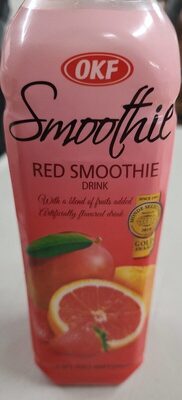
OKF Red Smoothie comes in a 500 ml pack. It is sold under the OKF brand. On Mamori it sits under Beverages › Juices & Smoothies › Smoothie. Its label lists 19 ingredients.
OKF Red Smoothie at a glance
OKF Red Smoothie carries the Gluten Free, Crustaceans Free, Egg Free, Fish Free, Peanut Free, Tree Nut Free, Celery Free, Mustard Free, Sesame Free, Lupin Free, Mollusks Free, Barley Free, Beef Free, Latex Free, Oats Free, Poultry Free, Rice Free, Rye Free and Wheat Free badges. Nutrition-wise, it's Low Salt/Sodium, Low Saturated Fat, Low Fiber, Low Protein, High in Sugars, Medium in Calories and Medium Carbs. Worth knowing: it's marked Non-Vegan, Non-Vegetarian, Non-Pescatarian, Non-Low FODMAP, Non-Vegan + Dairy, Non-Vegan + Eggs, Contains Soy, Contains Dairy, Contains Additives, Contains Artificial Flavourings, Contains Citrus Fruit, Contains Corn, Contains Emulsifier, Contains Fructose, Contains Gelatin, Lactose, Contains Added Sugars, Contains Pork and Contains Seed.
Diet and allergens
Not suitable for vegan, vegetarian or pescatarian diets.
Contains soy and milk.
Free from gluten, crustaceans, eggs, fish, peanuts, tree nuts, celery, mustard, sesame, lupin and molluscs.
Based on Mamori's check of the ingredients on the label. Recipes change, so always read the pack if you have an allergy or intolerance.
Size: 500 ml
Last updated 2 November 2026
Ingredients
Water, Fructose, grapefruit juice, Strawberry Juice, sugar, mango juice, Yoghurt Base, Skim Milk Powder, cellulose gum, flavours, Citric Acid, soybean polysaccharide, trisodium citrate, salt, Monoester P, Vitamin Complex, Enzymatically Modified Rutin, Red 40: E129, Yellow 6: E110
Additives & flavourings
Additives
- E466: Sodium Carboxy Methyl Cellulose, Cellulose Gum: Generally safe
Sodium carboxy methyl cellulose, also called cellulose gum or E466, is a modified cellulose. Cellulose is a natural fibre found in plant cell walls, and E466 is made by chemically changing it so it dissolves or disperses in water.
It is used as a thickener, stabiliser and emulsifier. It helps give foods a smooth texture, keep ingredients mixed, and control thickness. It can be found in products such as sauces, dressings, desserts, ice cream, baked goods and some reduced-fat foods.
E466 is generally considered safe. It is authorised for use in the EU after safety assessment, and the sources checked raise no concern at normal food amounts.
- E330: Citric Acid: Generally safe
Citric acid (E330) is a natural organic acid found in citrus fruits and many other plants. The citric acid used in food is usually made by fermentation of sugars using micro-organisms.
It is used as an acidity regulator and antioxidant. It helps give a sharp, sour taste, control pH, and slow colour or flavour changes. It is common in soft drinks, sweets, jams, sauces, canned foods, and many processed foods.
Citric acid is generally considered safe at normal food levels. It is allowed in food in the EU after safety assessment, and the sources checked raise no concern for typical dietary amounts.
- E331: Sodium Citrates (I) Monosodium Citrate (Ii) Disodium Citrate (Iii) Sodium Citrate (Trisodium Citrate): Generally safe
Sodium citrates (E331) are sodium salts of citric acid. They include monosodium, disodium and trisodium citrate, and are usually made by neutralising citric acid with a sodium compound.
They are used mainly as acidity regulators, helping control sourness and pH, and can also support antioxidant effects by binding metals. They are found in a wide range of foods, such as soft drinks, dairy products, processed cheese, desserts, jams and some meat products.
Sodium citrates are generally considered safe. They are authorised for use in food in the EU after EFSA safety assessment, and no concern is raised at normal amounts used in foods.
- E490: Propane-1,2-Diol: Not allowed in the EU (Regulation (EC) No 1333/2008, Article 4(1) and Annex II)
Propane-1,2-diol, also called propylene glycol, is E490. It is a clear, slightly sweet liquid made from petrochemical or plant-based raw materials. In food use, it belongs to additives that help carry, mix, or stabilise other ingredients.
It can act as a solvent, humectant, stabiliser, or emulsifier, helping flavours, colours, and other ingredients stay evenly mixed or retain moisture. It may be used in flavourings, colour preparations, and some processed foods where these functions are needed.
E490 is allowed in the EU within set limits. Its safety is controlled by maximum permitted levels and conditions of use, but it is not rated here.
- E129: Allura Red Ac (Fd&C Red 40): Some concerns
Allura Red AC (E129), also known as FD&C Red 40, is a synthetic red azo dye. It is a water-soluble colourant made for use in foods and drinks.
It gives a bright red to orange-red colour and is used in some sweets, soft drinks, desserts, ice lollies, bakery decorations and snack foods.
It is allowed for use, and EFSA’s 2015 assessment did not find a risk of eating too much at typical exposure levels. However, in the EU, foods containing it must carry a warning that it may have an adverse effect on activity and attention in children.
- E110: Sunset Yellow Fcf (Orange Yellow S, Fd&C Yellow 6): Some concerns
Sunset Yellow FCF, also called Orange Yellow S or E110, is a synthetic azo dye. It is a water-soluble orange-yellow colourant used to give foods and drinks a bright yellow to orange shade.
It is used in products such as soft drinks, sweets, desserts, sauces, snacks and bakery decorations, especially where a strong, stable colour is wanted.
It is allowed in the EU, but some concerns have been raised. Foods containing E110 must carry a warning that it “may have an adverse effect on activity and attention in children”.
Flavourings
- flavours: Flavouring (Regulation (EC) No 1334/2008 on flavourings, Article 16).
Questions and answers
Is OKF Red Smoothie vegan?
No. It contains milk, so it is not suitable for a vegan diet.
Is OKF Red Smoothie vegetarian?
No. It is not suitable for a vegetarian diet.
Is OKF Red Smoothie suitable for a pescatarian diet?
No. It is not suitable for a pescatarian diet.
Is OKF Red Smoothie suitable for a Low FODMAP diet?
No. It is not suitable for a Low FODMAP diet.
Is OKF Red Smoothie suitable for a Vegan + Dairy diet?
No. It is not suitable for a Vegan + Dairy diet.
Is OKF Red Smoothie suitable for a Vegan + Eggs diet?
No. It is not suitable for a Vegan + Eggs diet.
Is OKF Red Smoothie gluten-free?
Yes. Its ingredients include no gluten, and its label gives no gluten warning.
Does OKF Red Smoothie contain milk?
Yes. It contains milk.
Is OKF Red Smoothie nut-free?
Yes. Its ingredients include no peanuts or tree nuts, and its label gives no nut warning.
Does OKF Red Smoothie contain eggs?
No. Its ingredients include no eggs, and its label gives no egg warning.
Which allergens does OKF Red Smoothie contain?
It contains soy and milk.
More in Smoothie
- Del Monte Raspberry Smoothie
- Powerbar PowerGel Smoothie
- Naked Green Machine Smoothie
- Naked Gold Machine Smoothie
- Nakd Naked Blue Machine Smoothie
- Innocenr Innocent Super Smoothie Recharge
- Cold press Pineapple Coconut & Banana Smoothie
- Innocent Blue spark super smoothie
- Deva Nutrition DEVA smoothie Banana Mango Orange Apple
- OKF Green Smoothie
- OKF Mix Berry Smoothie
- OKF Yellow Smoothie