
Nestle Cheerios Multigrain 600 g
Nestle
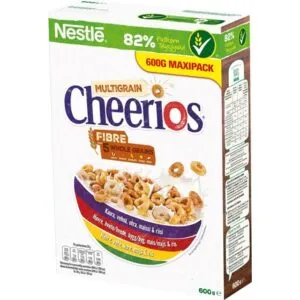
Nestle Cheerios Multigrain comes in a 600 g pack. It is sold under the Nestle brand. On Mamori it sits under Groceries › Cereal & Breakfast Biscuits › Cereal Flakes. Its label lists 27 ingredients.
Nestle Cheerios Multigrain at a glance
Nestle Cheerios Multigrain fits Vegetarian, Pescatarian and Vegan + Dairy diets. It also carries the Crustaceans Free, Egg Free, Fish Free, Peanut Free, Soy Free, Tree Nut Free, Celery Free, Mustard Free, Sesame Free, Lupin Free, Mollusks Free, Beef Free, Citrus Fruit Free, Emulsifier Free, Gelatin Free, Latex Free, Pork Free, Poultry Free and Rye Free badges. Nutrition-wise, it's High Fiber, Low Saturated Fat, High Carbs, High Salt/Sodium, Medium in Protein, Medium in Calories and Medium in Sugars. Worth knowing: it's marked Non-Vegan, Non-Low FODMAP, Non-Vegan + Eggs, Contains Gluten, Contains Additives, Contains Artificial Flavourings, Contains Barley, Contains Corn, Contains Fructose, Lactose, Contains Added Sugars, Contains Oats, Contains Rice, Contains Seed and Contains Wheat.
Diet and allergens
Suitable for vegetarian and pescatarian diets.
Not suitable for a vegan diet.
Contains gluten.
Free from crustaceans, eggs, fish, peanuts, soy, tree nuts, celery, mustard, sesame, lupin and molluscs.
Based on Mamori's check of the ingredients on the label. Recipes change, so always read the pack if you have an allergy or intolerance.
Size: 600 g
Last updated 2 November 2026
Ingredients
Cereal Grains, Whole Grain Oat Flour, whole grain WHEAT, Whole Grain Barley Flour, whole grain corn flour, whole grain rice flour, sugar, Wheat Starch, Partially Inverted Brown Sugar Syrup, salt, Acidity Regulator: Tripotassium Phosphate, Sunflower oil, Colours, caramel, Annatto, Carotene, Antioxidant: Tocopherols, Vitamins and Minerals, Vitamin C, niacin, Pantothenic acid, Riboflavin: Vitamin B2, Vitamin B6, Folic Acid, Vitamin D, calcium carbonate, Iron
Additives
- E340: Potassium Phosphates (I) Monopotassium Phosphate (Ii) Dipotassium Phosphate (Iii) Tripotassium Phosphate: Some concerns
Potassium phosphates (E340) are potassium salts of phosphoric acid. The group includes monopotassium phosphate, dipotassium phosphate and tripotassium phosphate. They are mineral-based phosphates used as acidity regulators and antioxidant-related stabilisers.
In food, E340 helps control acidity, stabilise mixtures, bind water and support texture. It may be used in processed meats, processed cheese, bakery products, powdered drinks, desserts and other processed foods where phosphate salts are useful.
E340 is allowed in food, but some concerns have been raised. EFSA found that people who eat many foods containing added phosphates can exceed the safe daily amount, and phosphate intake is a particular concern for people with kidney disease.
- E160B: Annatto, Bixin, Norbixin (E160b): Generally safe
Annatto, bixin and norbixin are orange-red colourings known as E160b. They are natural pigments extracted from the seeds of the annatto tree. Bixin is oil-soluble, while norbixin is water-soluble.
They are used to give foods a yellow, orange or red colour. They are commonly used in foods such as cheese, butter-like spreads, snacks, desserts and processed foods where a stable colour is needed.
E160b is generally considered safe at normal amounts. It is allowed in food in the EU after EFSA safety assessment, and the sources checked raise no concern for typical dietary exposure.
- E160a: Carotenes: Generally safe
Carotenes (E160a) are orange-yellow colourants, including alpha-carotene, beta-carotene and gamma-carotene. They are pigments found naturally in plants such as carrots and leafy greens, and can also be made synthetically or obtained from natural sources. Some forms may be animal derived.
They are used to add or restore yellow to orange colour in foods. They may be found in products such as margarines, dairy products, desserts, sauces, drinks and confectionery.
E160a is allowed in food in the EU after safety assessment. It is generally considered safe at normal food amounts, and the sources checked raise no concern for typical use.
- E300: Ascorbic Acid (Vitamin C): Generally safe
Ascorbic acid (E300) is vitamin C, a water-soluble substance found naturally in many fruits and vegetables. As a food additive, it is usually made by controlled industrial production and used in purified form.
It helps prevent oxidation, which can stop foods from browning or developing off-flavours. It can also adjust acidity. It is used in a range of foods, especially fruit products, drinks, bakery products, meat products and foods where colour or freshness needs protecting.
It is generally considered safe at normal food amounts. It is authorised for use in the EU after safety assessment, and EFSA’s re-evaluation did not raise concern for its use as a food additive.
- E170: Calcium Carbonate, Chalk: Generally safe
Calcium carbonate (E170), also known as chalk, is a naturally occurring mineral made of calcium, carbon and oxygen. For food use it is purified, and it may come from sources such as limestone or shells.
It is mainly used as a white colourant, but it can also help with acidity control, anti-caking, or as a calcium source in some foods. It may be found in confectionery, chewing gum, bakery products, decorations and some supplements or fortified foods.
It is generally considered safe at normal food amounts. It is authorised for use in the EU after safety assessment, and the sources checked raise no concern for typical dietary exposure.
Questions and answers
Is Nestle Cheerios Multigrain vegan?
No. It is not suitable for a vegan diet.
Is Nestle Cheerios Multigrain vegetarian?
Yes. It is suitable for a vegetarian diet.
Is Nestle Cheerios Multigrain suitable for a pescatarian diet?
Yes. It is suitable for a pescatarian diet.
Is Nestle Cheerios Multigrain suitable for a Low FODMAP diet?
No. It is not suitable for a Low FODMAP diet.
Is Nestle Cheerios Multigrain suitable for a Vegan + Dairy diet?
Yes. It is suitable for a Vegan + Dairy diet.
Is Nestle Cheerios Multigrain suitable for a Vegan + Eggs diet?
No. It is not suitable for a Vegan + Eggs diet.
Is Nestle Cheerios Multigrain gluten-free?
No. It contains gluten.
Is Nestle Cheerios Multigrain nut-free?
Yes. Its ingredients include no peanuts or tree nuts, and its label gives no nut warning.
Does Nestle Cheerios Multigrain contain eggs?
No. Its ingredients include no eggs, and its label gives no egg warning.
Which allergens does Nestle Cheerios Multigrain contain?
It contains gluten.
More in Cereal Flakes
- Crownfield Special Flakes Fruit & Fibre
- Co-op Rice flakes with whole wheat and barley
- Lidl Cinnamon Churros
- Todis Cereal Flakes
- Engevita Nutritional Yeast Flakes Protein & Fibre Unfortified
- Harrisons Cherokee
- Nestle Golden Minis Cereal
- Doves farm Fibre Flakes
- Carrefour Stylesse Petals of Rice and Whole Wheat
- Carrefour Fiber Flakes
- Mulino Bianco Pan Di Stelle Cereals
- Weetabix Alpen Alpen Original No Added Sugar