
Montana Ham 200 g
Montana
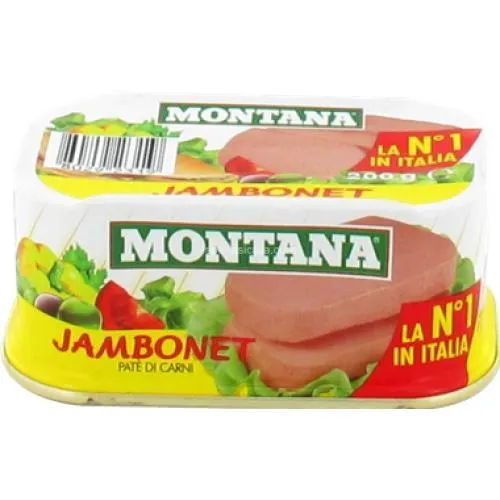
Montana Ham comes in a 200 g pack. It is sold under the Montana brand. On Mamori it sits under Meat and Seafood › Processed Meats › Ham. Its label lists 12 ingredients.
Montana Ham at a glance
Montana Ham carries the Crustaceans Free, Egg Free, Fish Free, Peanut Free, Soy Free, Dairy Free, Tree Nut Free, Celery Free, Mustard Free, Sesame Free, Sulfite Free, Lupin Free, Mollusks Free, Barley Free, Citrus Fruit Free, Fructose Free, Gelatin Free, Lactose Free, Latex Free, No Added Sugars, Poultry Free and Rye Free badges. Nutrition-wise, it's High Protein, Low Carbs, Low Sugars, Low Fiber, High Salt/Sodium, High Saturated Fat and Medium in Calories. Worth knowing: it's marked Non-Vegan, Non-Vegetarian, Non-Pescatarian, Non-Low FODMAP, Non-Vegan + Dairy, Non-Vegan + Eggs, Contains Gluten, Contains Additives, Contains Artificial Flavourings, Contains Beef, Contains Corn, Contains Emulsifier, Contains Oats, Contains Pork, Contains Rice, Contains Seed and Contains Wheat.
Diet and allergens
Not suitable for vegan, vegetarian or pescatarian diets.
Contains gluten.
Free from crustaceans, eggs, fish, peanuts, soy, milk, tree nuts, celery, mustard, sesame, sulphites, lupin and molluscs.
Based on Mamori's check of the ingredients on the label. Recipes change, so always read the pack if you have an allergy or intolerance.
Size: 200 g
Last updated 2 November 2026
Ingredients
beef, Water, Pork, pork fat, Rice flour, Wheat Fiber, Aromas, thickener: quar gum, salt, stabilizer: polyphosphates, flavor enhancer: monosodium glutamate, preservative: sodium nitrite
Additives & flavourings
Additives
- E411: Oat Gum (Thickener): Not allowed in the EU (Regulation (EC) No 1333/2008, Article 4(1) and Annex II)
Oat gum, E411, is a food gum obtained from oats. It is mainly made up of soluble fibre, including beta-glucans, and forms a thick, gel-like texture when mixed with water.
It is used as a thickener, stabiliser or emulsifier, helping foods hold moisture, improve texture, or keep ingredients evenly mixed. These functions are used in products such as sauces, dressings, desserts, bakery fillings and other processed foods.
Its safety rating is not yet set here. E411 is allowed in the EU within set limits, meaning it can be used in permitted foods at regulated levels.
- E452: Polyphosphates (I) Sodium Polyphosphates (Ii) Potassium Polyphosphates (Iii) Sodium Calcium Polyphosphate (Iv) Calcium Polyphosphates (V) Ammonium Polyphosphate: Some concerns
Polyphosphates (E452) are phosphate salts, including sodium, potassium, sodium calcium, calcium and ammonium polyphosphates. They are made from phosphoric acid compounds and belong to the wider group of phosphate additives.
They help foods hold water, keep texture stable, emulsify mixtures and improve thickness. They are used in foods such as processed meat and fish products, cheese products, sauces, desserts and some bakery or potato products.
They are allowed in food, but some concerns have been raised. EFSA found that people who eat a lot of foods containing phosphate additives can exceed the safe daily amount, so exposure may be high for frequent consumers.
- E621: monosodium glutamate: Some concerns
Monosodium glutamate, or MSG (E621), is the sodium salt of glutamic acid, an amino acid found naturally in many foods. It is made as a purified flavour enhancer.
It boosts savoury “umami” taste and is used in foods such as soups, sauces, seasonings, savoury snacks, ready meals and processed meat or vegetable dishes.
It is allowed in food, but some concerns have been raised. EFSA found that people who eat a lot of foods containing glutamates can go over the safe daily amount, so exposure may be high for frequent consumers.
- E250: Sodium Nitrite: Best avoided
Sodium nitrite (E250) is a preservative made from sodium and nitrite salts. It is closely related to potassium nitrite (E249) and is used in small amounts because it is very active.
It helps stop dangerous bacteria growing and helps cured meats keep their pink colour and flavour. It is mainly found in processed and cured meats such as bacon, ham, sausages, salami and other similar products.
This additive is best avoided. Nitrites can help form nitrosamines under some conditions, which are classed as probably causing cancer, and processed meat is classed as causing cancer; high consumers may also exceed the safe daily amount.
Flavourings
- Aromas: Flavouring (Regulation (EC) No 1334/2008 on flavourings, Article 16).
Questions and answers
Is Montana Ham vegan?
No. It is not suitable for a vegan diet.
Is Montana Ham vegetarian?
No. It is not suitable for a vegetarian diet.
Is Montana Ham suitable for a pescatarian diet?
No. It is not suitable for a pescatarian diet.
Is Montana Ham suitable for a Low FODMAP diet?
No. It is not suitable for a Low FODMAP diet.
Is Montana Ham suitable for a Vegan + Dairy diet?
No. It is not suitable for a Vegan + Dairy diet.
Is Montana Ham suitable for a Vegan + Eggs diet?
No. It is not suitable for a Vegan + Eggs diet.
Is Montana Ham gluten-free?
No. It contains gluten.
Does Montana Ham contain milk?
No. Its ingredients include no milk, and its label gives no milk warning.
Is Montana Ham nut-free?
Yes. Its ingredients include no peanuts or tree nuts, and its label gives no nut warning.
Does Montana Ham contain eggs?
No. Its ingredients include no eggs, and its label gives no egg warning.
Which allergens does Montana Ham contain?
It contains gluten.