
Kopiko Brown Coffee 275 g
Kopiko
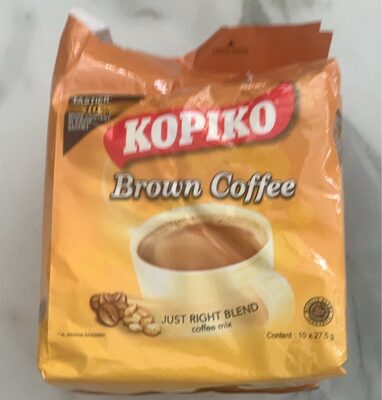
Kopiko Brown Coffee comes in a 275 g pack. It is sold under the Kopiko brand. On Mamori it sits under Beverages › Coffee › Instant Coffee. Its label lists 29 ingredients.
Kopiko Brown Coffee at a glance
Kopiko Brown Coffee carries the Crustaceans Free, Egg Free, Fish Free, Peanut Free, Soy Free, Tree Nut Free, Celery Free, Mustard Free, Sesame Free, Lupin Free, Mollusks Free, Beef Free, Citrus Fruit Free, Gelatin Free, Latex Free, Oats Free, Pork Free, Poultry Free and Rice Free badges. Nutrition-wise, it's Low Fiber, Low Protein, High Calorie, High Carbs, High Saturated Fat, High in Sugars and Medium Salt/Sodium. Worth knowing: it's marked Non-Vegan, Non-Vegetarian, Non-Pescatarian, Non-Low FODMAP, Non-Vegan + Dairy, Non-Vegan + Eggs, Contains Dairy, Contains Additives, Contains Artificial Flavourings, Contains Barley, Contains Corn, Contains Emulsifier, Contains Fructose, Lactose, Contains Added Sugars, Contains Rye, Contains Seed and Contains Wheat.
Diet and allergens
Not suitable for vegan, vegetarian or pescatarian diets.
Contains milk.
Free from crustaceans, eggs, fish, peanuts, soy, tree nuts, celery, mustard, sesame, lupin and molluscs.
Based on Mamori's check of the ingredients on the label. Recipes change, so always read the pack if you have an allergy or intolerance.
Size: 275 g
Last updated 13 November 2026
Ingredients
Sugar, Milk whitener, glucose syrup, hydrogenated vegetable fat, coconut oil, palm kernel oil, sodium caseinate, stabilizer: E340, emulsifier, E471, E481, stabilizer: E452, anti-caking agent: E551, Instant coffee, foaming coffee whitener, glucose syrup solids, vegetable fat, coconut oil, palm oil, MILK SOLIDS, stabilizer: E340, emulsifier: E481, flavor, MALT EXTRACT, SKIMMED MILK POWDER, Cocoa powder, Palm sugar, artificial milk flavor, Vanillin
Additives & flavourings
Additives
- E340: Potassium Phosphates (I) Monopotassium Phosphate (Ii) Dipotassium Phosphate (Iii) Tripotassium Phosphate: Some concerns
Potassium phosphates (E340) are potassium salts of phosphoric acid. The group includes monopotassium phosphate, dipotassium phosphate and tripotassium phosphate. They are mineral-based phosphates used as acidity regulators and antioxidant-related stabilisers.
In food, E340 helps control acidity, stabilise mixtures, bind water and support texture. It may be used in processed meats, processed cheese, bakery products, powdered drinks, desserts and other processed foods where phosphate salts are useful.
E340 is allowed in food, but some concerns have been raised. EFSA found that people who eat many foods containing added phosphates can exceed the safe daily amount, and phosphate intake is a particular concern for people with kidney disease.
- E471: Mono- And Diglycerides Of Fatty Acids (Glyceryl Monostearate, Glyceryl Distearate): Generally safe
Mono- and diglycerides of fatty acids, or E471, are emulsifiers made from glycerol and fatty acids. The fatty acids can come from vegetable oils or animal fats, so the source is not always clear unless stated by the producer.
They help oil and water mix, improve texture, and keep foods stable. They are often used in baked goods, spreads, desserts, ice cream, sauces, and processed foods where a smooth or consistent texture is needed.
E471 is generally considered safe. It is allowed in food in the EU after safety assessment, and the sources we check raise no concern at normal amounts.
- E481: Sodium Stearoyl-2-Lactylate: Some concerns
Sodium stearoyl-2-lactylate (E481) is an emulsifier and stabiliser made by combining stearic acid with lactic acid, then forming the sodium salt. The stearic acid can come from vegetable or animal fats.
It helps oil and water mix, strengthens dough, improves texture, and can help foods stay soft for longer. It is used especially in bread and bakery products, and may also be found in some desserts, processed potato products, and emulsified foods.
It is allowed in food, but some concerns have been raised. EFSA found that people who eat a lot of foods containing it could go over the safe daily amount.
- E452: Polyphosphates (I) Sodium Polyphosphates (Ii) Potassium Polyphosphates (Iii) Sodium Calcium Polyphosphate (Iv) Calcium Polyphosphates (V) Ammonium Polyphosphate: Some concerns
Polyphosphates (E452) are phosphate salts, including sodium, potassium, sodium calcium, calcium and ammonium polyphosphates. They are made from phosphoric acid compounds and belong to the wider group of phosphate additives.
They help foods hold water, keep texture stable, emulsify mixtures and improve thickness. They are used in foods such as processed meat and fish products, cheese products, sauces, desserts and some bakery or potato products.
They are allowed in food, but some concerns have been raised. EFSA found that people who eat a lot of foods containing phosphate additives can exceed the safe daily amount, so exposure may be high for frequent consumers.
- E551: Silicon Dioxide (Silica): Generally safe
Silicon dioxide (E551), also called silica, is a naturally occurring mineral substance made of silicon and oxygen. It is found in rocks, sand and many plants, and the food additive form is a fine, inert powder.
In food, it is mainly used as an anti-caking agent to help powders and granules flow freely. It may be found in products such as powdered seasonings, salt substitutes, dried soups, instant drinks and food supplement powders.
It is generally considered safe at normal food-use levels. It is authorised for use in the EU after safety assessment, and the sources checked raise no concern at typical amounts.
- E627: Disodium Guanylate: Generally safe
Disodium guanylate (E627) is a flavour enhancer made from guanylic acid, a substance related to natural nucleotides found in living cells. It can be produced by fermentation or extracted from natural sources, and may sometimes be animal derived.
It is used to boost savoury, meaty or “umami” flavours, often together with monosodium glutamate (MSG). It may be found in foods such as soups, sauces, seasonings, savoury snacks, instant noodles and processed meat products.
E627 is generally considered safe at normal amounts used in food. It is authorised for use in the EU after safety assessment, and the sources checked raise no concern for typical dietary exposure.
Flavourings
- flavor: Flavouring (Regulation (EC) No 1334/2008 on flavourings, Article 16).
- artificial milk flavor: Flavouring.
- Vanillin: Flavouring (EU Union list of flavouring substances: Vanillin). Vanillin is a flavouring substance on the EU Union list.
Questions and answers
Is Kopiko Brown Coffee vegan?
No. It contains milk, so it is not suitable for a vegan diet.
Is Kopiko Brown Coffee vegetarian?
No. It is not suitable for a vegetarian diet.
Is Kopiko Brown Coffee suitable for a pescatarian diet?
No. It is not suitable for a pescatarian diet.
Is Kopiko Brown Coffee suitable for a Low FODMAP diet?
No. It is not suitable for a Low FODMAP diet.
Is Kopiko Brown Coffee suitable for a Vegan + Dairy diet?
No. It is not suitable for a Vegan + Dairy diet.
Is Kopiko Brown Coffee suitable for a Vegan + Eggs diet?
No. It is not suitable for a Vegan + Eggs diet.
Does Kopiko Brown Coffee contain milk?
Yes. It contains milk.
Is Kopiko Brown Coffee nut-free?
Yes. Its ingredients include no peanuts or tree nuts, and its label gives no nut warning.
Does Kopiko Brown Coffee contain eggs?
No. Its ingredients include no eggs, and its label gives no egg warning.
Which allergens does Kopiko Brown Coffee contain?
It contains milk.
More in Instant Coffee
- NESCAFE = GREEN TRIANGLE MOCHA FLAVOUR Quality Str
- NY Coffee Ny 2 In 1 White Coffee Sachets Value 10pk
- NY Coffee Ny 3 In 1 White Coffee & Sugar Sachets Value 10pk
- Mokate Gold Premium Irish Latte 10pk
- Mokate Gold Latte Classic 8 Pack
- Gran Caffe Garibaldi Dolce Gusto Ginseng 16 Capsules
- Beanies Beanis Amaretto Almond Instant Coffee
- Trung Nguyen Instant Coffee 3 In 1
- Mokate 2in1 instant coffee box XXL
- Mokate 5900649080072
- Kimbo Fresh Ground Coffee
- Borbone Sambuchino