
Haribo marshmallows
On the pack: Haribo chamallows
Haribo,
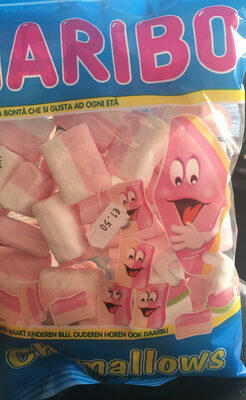
Haribo marshmallows is listed on Mamori. It is sold under the Haribo brand. On Mamori it sits under Confectionery › Candy, Sweets & Nougat › Marshmallow. Its label lists 10 ingredients.
Haribo marshmallows at a glance
Haribo marshmallows carries the Gluten Free, Crustaceans Free, Egg Free, Fish Free, Peanut Free, Soy Free, Dairy Free, Tree Nut Free, Celery Free, Mustard Free, Sesame Free, Sulfite Free, Lupin Free, Mollusks Free, Barley Free, Citrus Fruit Free, Lactose Free, Latex Free, Oats Free, Poultry Free, Rice Free, Rye Free, Seed Free and Wheat Free badges. Nutrition-wise, it's Low Salt/Sodium, Low Saturated Fat, Low Fiber, Low Protein, High Carbs, High in Sugars and Medium in Calories. Worth knowing: it's marked Non-Vegan, Non-Vegetarian, Non-Pescatarian, Non-Low FODMAP, Non-Vegan + Dairy, Non-Vegan + Eggs, Contains Additives, Contains Artificial Flavourings, Contains Beef, Contains Corn, Contains Emulsifier, Contains Fructose, Contains Gelatin, Contains Added Sugars and Contains Pork.
Diet and allergens
Not suitable for vegan, vegetarian or pescatarian diets.
Free from all 14 major allergens: gluten, crustaceans, eggs, fish, peanuts, soy, milk, tree nuts, celery, mustard, sesame, sulphites, lupin and molluscs.
Based on Mamori's check of the ingredients on the label. Recipes change, so always read the pack if you have an allergy or intolerance.
Last updated 22 September 2026
Ingredients
glucose syrup, sugar, water, humectant: sorbitol syrup, gelatin, dextrose, flavoring, colorings, carmine, curcumin
Additives & flavourings
Additives
- E420: Sorbitol (I) Sorbitol (Ii) Sorbitol Syrup (Emulsifier) (Sweetener): Generally safe
Sorbitols (E420) are sugar alcohols used as food additives. They include sorbitol and sorbitol syrup, made from glucose, often from starch sources. Despite the name, they are not alcoholic drinks.
They are used to add sweetness, keep foods moist, improve texture, and help stabilise mixtures. They are often found in sugar-free sweets and chewing gum, desserts, baked goods, sauces, and some processed foods.
Sorbitols are generally considered safe at normal food amounts. They are authorised for use in the EU after safety assessment, and the sources checked raise no concern for typical intake.
- E441: Gelatine (Emulsifier): Generally safe
Gelatine, sometimes listed as E441, is a protein-based ingredient made by processing collagen from animal skin, bones and connective tissue, usually from pigs or cattle.
It helps foods set, thicken, stabilise or give a smooth texture. It is commonly used in jellies, marshmallows, gummy sweets, desserts, yoghurts and some low-fat spreads or meat products.
It is generally considered safe for most people. Under EU law, edible gelatine is treated as a food ingredient rather than a food additive, so it is not classed as an additive in Regulation (EC) No 1333/2008.
- E120: Cochineal, Carminic Acid, Carmine (Natural Red 4): Generally safe
Carminic acid and carmine (E120) are red colourants made from cochineal insects. They are also known as cochineal or Natural Red 4, and are not suitable for people avoiding animal-derived ingredients.
They are used to give foods a red, pink, or purple colour. E120 may be found in products such as confectionery, desserts, drinks, yoghurts, processed meats, and sauces where a stable red colour is needed.
E120 is generally considered safe at normal food amounts. It is authorised for use in the EU after EFSA safety assessment, and the sources checked do not raise concerns for typical dietary exposure.
- E100: Curcumin (From Turmeric): Generally safe
Curcumin (E100) is a yellow-orange food colour made from turmeric, the spice from the root of the Curcuma longa plant. It is the main natural pigment in turmeric and may also be produced as a purified extract for food use.
It is used to give foods a yellow to orange colour. It can be found in products such as sauces, soups, snacks, confectionery, dairy products and processed foods where a warm yellow colour is wanted.
Curcumin is generally considered safe at normal food amounts. It is allowed for use in the EU after EFSA safety assessment, and the sources checked do not raise concerns for typical dietary exposure.
Flavourings
- flavoring: Flavouring (Regulation (EC) No 1334/2008 on flavourings, Article 16).
Questions and answers
Is Haribo marshmallows vegan?
No. It is not suitable for a vegan diet.
Is Haribo marshmallows vegetarian?
No. It is not suitable for a vegetarian diet.
Is Haribo marshmallows suitable for a pescatarian diet?
No. It is not suitable for a pescatarian diet.
Is Haribo marshmallows suitable for a Low FODMAP diet?
No. It is not suitable for a Low FODMAP diet.
Is Haribo marshmallows suitable for a Vegan + Dairy diet?
No. It is not suitable for a Vegan + Dairy diet.
Is Haribo marshmallows suitable for a Vegan + Eggs diet?
No. It is not suitable for a Vegan + Eggs diet.
Is Haribo marshmallows gluten-free?
Yes. Its ingredients include no gluten, and its label gives no gluten warning.
Does Haribo marshmallows contain milk?
No. Its ingredients include no milk, and its label gives no milk warning.
Is Haribo marshmallows nut-free?
Yes. Its ingredients include no peanuts or tree nuts, and its label gives no nut warning.
Does Haribo marshmallows contain eggs?
No. Its ingredients include no eggs, and its label gives no egg warning.
More in Marshmallow
- Lidl Marshmallows
- Lanesch Marshmallows In Choco
- Laima Mini Vanilla Marshmallows In Chocolate Zefir
- Haribo Chamallows mallow mix
- Barratt Mini flumps
- Vidal Flaming Mallows
- Hamlet Rainbow Mallows Unicorn
- Hamlet Bbq Mallows Tutti Frutti
- Epic Giant Toastin Marshmallows
- Trolli Marsh Mallows
- Not Just BBQ Marshmallows XXL Bag
- Not Just BBQ Bbq Marshmallow Tube