
Greens Carmelle Vanilla Dessert With Caramel Syrup 70 g
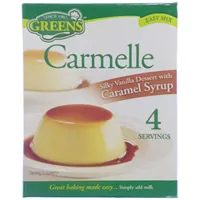
Greens Carmelle Vanilla Dessert With Caramel Syrup comes in a 70 g pack. On Mamori it sits under Groceries › Jelly, Custard & Desserts › Pudding. Its label lists 15 ingredients.
Greens Carmelle Vanilla Dessert With Caramel Syrup at a glance
Greens Carmelle Vanilla Dessert With Caramel Syrup fits Vegan, Vegetarian, Pescatarian and Vegan + Eggs diets. It also carries the Crustaceans Free, Fish Free, Celery Free, Mustard Free, Sesame Free, Mollusks Free, Barley Free, Beef Free, Citrus Fruit Free, Gelatin Free, Lactose Free, Latex Free, Pork Free, Poultry Free and Rice Free badges. Nutrition-wise, it's Low Salt/Sodium, Low Fiber, Low Protein, High Carbs, High in Sugars, Medium in Calories and Medium Saturated Fat. Worth knowing: it's marked Non-Low FODMAP, Non-Vegan + Dairy, Contains Additives, Contains Artificial Flavourings, Contains Corn, Contains Emulsifier, Contains Fructose, Contains Added Sugars, Contains Oats, Contains Rye, Contains Seed and Contains Wheat.
Diet and allergens
Suitable for vegan, vegetarian and pescatarian diets.
Free from crustaceans, fish, celery, mustard, sesame and molluscs.
May contain: Eggs, Nuts, PEANUTS, Wheat, Oats, soya.
Based on Mamori's check of the ingredients on the label. Recipes change, so always read the pack if you have an allergy or intolerance.
Size: 70 g
Last updated 2 November 2026
Ingredients
sugar, gelling agent: carrageenan, stabilisers, E339: ii, E450, colours, Annatto norbixin, Curcumin, flavouring, syrup, sugar, colours, E150d, E150c, flavouring
Additives & flavourings
Additives
- E407: Carrageenan (Thickener) (Stabiliser) (Gelling Agent): Some concerns
Carrageenan, or E407, is a thickening and gelling additive made from red seaweed. It is a large carbohydrate substance used to change the texture of foods.
It helps foods become thicker, creamier or more stable, and can also help gels form. It is often used in dairy desserts, flavoured milks, ice cream, plant-based drinks, sauces and processed meats.
It is allowed in food, but some concerns have been raised. EFSA found that people who eat a lot of foods containing carrageenan could go over the safe daily amount, so high intake is the main issue.
- E339: Sodium Phosphates (I) Monosodium Phosphate (Ii) Disodium Phosphate (Iii) Trisodium Phosphate: Some concerns
Sodium phosphates (E339) are salts of phosphoric acid and sodium. They include monosodium, disodium and trisodium phosphate, and are used as acidity regulators and antioxidants.
They help control acidity, keep mixtures stable, improve texture, and support moisture retention. They can be found in processed cheese, meat products, baked goods, powdered mixes and some drinks.
They are allowed in food, but some concerns have been raised. EFSA found that people who eat a lot of foods containing phosphate additives can exceed the safe daily amount, and people with kidney disease are usually advised to limit phosphate intake.
- E450: Diphosphates (I) Disodium Diphosphate (Ii) Trisodium Diphosphate (Iii) Tetrasodium Diphosphate (Iv) Dipotassium Diphosphate (V) Tetrapotassium Diphosphate (Vi) Dicalcium Diphosphate (Vii) Calcium Dihydrogen Diphosphate: Some concerns
Diphosphates (E450) are phosphate salts, including sodium, potassium and calcium diphosphates. They are mineral-based food additives used in several forms, such as disodium diphosphate and dicalcium diphosphate.
They help control acidity, improve texture, hold moisture, stabilise mixtures and support raising in baked goods. They may be found in processed meats, bakery products, cheese products, desserts, sauces and some powdered mixes.
They are allowed in food, but some concerns have been raised. EFSA found that people who eat a lot of foods containing phosphates can go over the safe daily amount, so high intake from many processed foods is the main issue.
- E160b(ii): Annatto Norbixin: Generally safe
Annatto norbixin (E160b(ii)) is an orange-yellow food colour made from annatto, a natural pigment from the seeds of the achiote tree. Norbixin is the water-soluble form of the colour.
It is used to give foods a yellow to orange shade. It can be found in products such as cheeses, dairy desserts, spreads, snacks, sauces and some processed foods where a stable colour is needed.
It is generally considered safe at normal food levels. It is allowed in food in the EU after safety assessment by EFSA, and the sources checked raise no concern for typical use.
- E100: Curcumin (From Turmeric): Generally safe
Curcumin (E100) is a yellow-orange food colour made from turmeric, the spice from the root of the Curcuma longa plant. It is the main natural pigment in turmeric and may also be produced as a purified extract for food use.
It is used to give foods a yellow to orange colour. It can be found in products such as sauces, soups, snacks, confectionery, dairy products and processed foods where a warm yellow colour is wanted.
Curcumin is generally considered safe at normal food amounts. It is allowed for use in the EU after EFSA safety assessment, and the sources checked do not raise concerns for typical dietary exposure.
- E150D: Sulfite Ammonia Caramel (E150d): Some concerns
Sulphite ammonia caramel (E150d) is a dark brown food colour. It is a type of caramel colour made by heating sugars with sulphite and ammonia compounds, producing a stable colouring mixture rather than a flavour caramel.
It is used to give foods and drinks a brown colour and to keep colour consistent. It is commonly found in cola-style soft drinks, sauces, soups, beers, vinegars, and some processed savoury foods.
It is allowed for use, but some concerns have been raised because 4-methylimidazole, a by-product that can form when making these caramel colours, is classed by IARC as possibly causing cancer (Group 2B).
- E150C: Ammonia Caramel (E150c): Some concerns
Ammonia caramel (E150c) is a brown food colour made by heating sugars with ammonia compounds. It is one of the caramel colours, used to give foods and drinks a darker brown appearance.
It is used in products such as soft drinks, sauces, soups, baked goods, confectionery and some processed savoury foods, where a stable brown colour is needed.
It is allowed in food, but some concerns have been raised. A by-product that can form during manufacture, 4-methylimidazole, is classed by IARC as possibly causing cancer, and EFSA has found that people with high intakes of caramel colours may exceed the safe daily amount.
Flavourings
- flavouring: Flavouring (Regulation (EC) No 1334/2008 on flavourings, Article 16).
- flavouring: Flavouring (Regulation (EC) No 1334/2008 on flavourings, Article 16).
Questions and answers
Is Greens Carmelle Vanilla Dessert With Caramel Syrup vegan?
Yes. It is suitable for a vegan diet.
Is Greens Carmelle Vanilla Dessert With Caramel Syrup vegetarian?
Yes. It is suitable for a vegetarian diet.
Is Greens Carmelle Vanilla Dessert With Caramel Syrup suitable for a pescatarian diet?
Yes. It is suitable for a pescatarian diet.
Is Greens Carmelle Vanilla Dessert With Caramel Syrup suitable for a Low FODMAP diet?
No. It is not suitable for a Low FODMAP diet.
Is Greens Carmelle Vanilla Dessert With Caramel Syrup suitable for a Vegan + Dairy diet?
No. It is not suitable for a Vegan + Dairy diet.
Is Greens Carmelle Vanilla Dessert With Caramel Syrup suitable for a Vegan + Eggs diet?
Yes. It is suitable for a Vegan + Eggs diet.
Does Greens Carmelle Vanilla Dessert With Caramel Syrup carry an allergy warning?
Yes. Its label says it may contain: Eggs, Nuts, PEANUTS, Wheat, Oats, soya.
More in Pudding
- Arla Vanilla Cookie flavor Protein pudding
- Zott Protein Pudding Chocolate Taste
- Lidl Caramel pudding
- Pilis Chocolate and vanilla flavored dessert cream
- Pilos Rice pudding
- Albona High Protein Rice Pudding
- Ruf Pudding Powder Vanilla
- Aunty's Puddings Aunty's Spotted Dick Puddings
- Twinnings Aunty's Delicious Sticky Toffee Steamed Puds
- Arla Salted Caramel Protein Milk Dessert
- Zott Protein Chocolate Pudding
- Zott Protein Pudding Vanilla Taste