
Camel Brand Salami Dip 230 g
Camel Brand
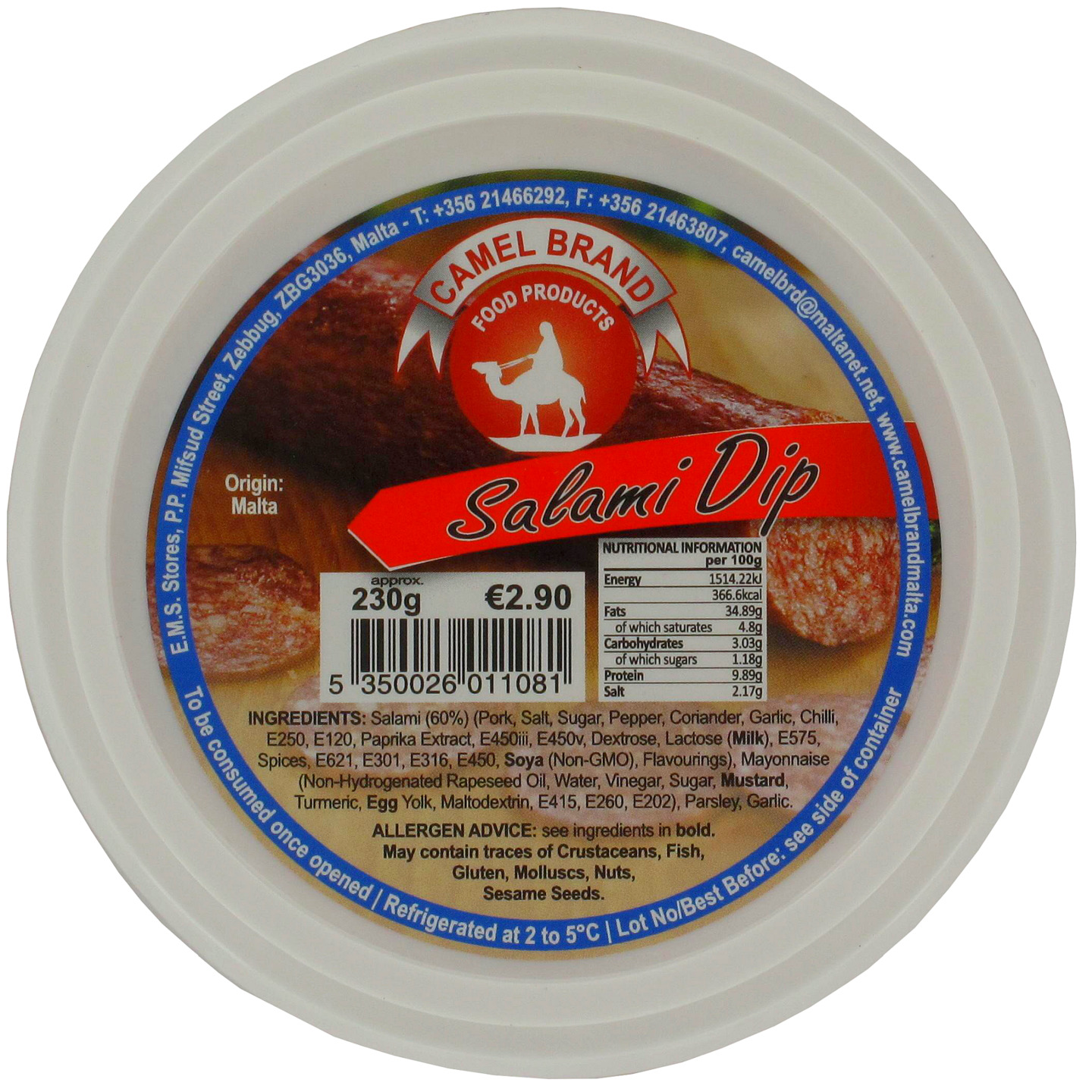
Camel Brand Salami Dip comes in a 230 g pack. It is sold under the Camel Brand brand. On Mamori it sits under Chilled › Antipasti › Dips. Its label lists 37 ingredients.
Camel Brand Salami Dip at a glance
Camel Brand Salami Dip carries the Gluten Free, Crustaceans Free, Fish Free, Peanut Free, Tree Nut Free, Celery Free, Sesame Free, Lupin Free, Mollusks Free, Barley Free, Beef Free, Citrus Fruit Free, Gelatin Free, Latex Free, Oats Free, Poultry Free and Rye Free badges. Nutrition-wise, it's Low Carbs, Low Saturated Fat, Low Sugars, Low Fiber, High Salt/Sodium, Medium in Protein and Medium in Calories. Worth knowing: it's marked Non-Vegan, Non-Vegetarian, Non-Pescatarian, Non-Low FODMAP, Non-Vegan + Dairy, Non-Vegan + Eggs, Contains Egg, Contains Soy, Contains Dairy, Contains Mustard, Contains Additives, Contains Artificial Flavourings, Contains Corn, Contains Emulsifier, Contains Fructose, Lactose, Contains Added Sugars, Contains Pork, Contains Rice, Contains Seed and Contains Wheat.
Diet and allergens
Not suitable for vegan, vegetarian or pescatarian diets.
Contains eggs, soy, milk and mustard.
Free from gluten, crustaceans, fish, peanuts, tree nuts, celery, sesame, lupin and molluscs.
Based on Mamori's check of the ingredients on the label. Recipes change, so always read the pack if you have an allergy or intolerance.
Size: 230 g
Last updated 2 November 2026
Ingredients
salami, Pork, salt, sugar, Pepper, Coriander, Garlic, Chilli, E250, E120, Paprika Extract, E450iii, E450v, dextrose, Lactose, e575, spices, E621, E301, E316, E450, soya:non-GMO, Flavourings, mayonnaise, non-hydrogenated rapeseed oil, Water, Vinegar, sugar, mustard, turmeric, Egg Yolk, Maltodextrin, E415, E260, E202, parsley, Garlic
Additives & flavourings
Additives
- E250: Sodium Nitrite: Best avoided
Sodium nitrite (E250) is a preservative made from sodium and nitrite salts. It is closely related to potassium nitrite (E249) and is used in small amounts because it is very active.
It helps stop dangerous bacteria growing and helps cured meats keep their pink colour and flavour. It is mainly found in processed and cured meats such as bacon, ham, sausages, salami and other similar products.
This additive is best avoided. Nitrites can help form nitrosamines under some conditions, which are classed as probably causing cancer, and processed meat is classed as causing cancer; high consumers may also exceed the safe daily amount.
- E120: Cochineal, Carminic Acid, Carmine (Natural Red 4): Generally safe
Carminic acid and carmine (E120) are red colourants made from cochineal insects. They are also known as cochineal or Natural Red 4, and are not suitable for people avoiding animal-derived ingredients.
They are used to give foods a red, pink, or purple colour. E120 may be found in products such as confectionery, desserts, drinks, yoghurts, processed meats, and sauces where a stable red colour is needed.
E120 is generally considered safe at normal food amounts. It is authorised for use in the EU after EFSA safety assessment, and the sources checked do not raise concerns for typical dietary exposure.
- E160c: Paprika Extract, Capsanthin, Capsorubin: Generally safe
Paprika extract, capsanthin and capsorubin (E160c) is a natural red-orange food colouring made from paprika peppers. The main colouring substances are carotenoids, especially capsanthin and capsorubin.
It is used to give or strengthen orange, red or reddish-brown colour in foods. It may be found in items such as cheeses, sauces, soups, snacks, meat products and seasonings.
It is generally considered safe at normal food-use amounts. It is authorised for use in the EU after EFSA safety assessment, and the sources checked raise no concern at typical levels of consumption.
- E450: Diphosphates (I) Disodium Diphosphate (Ii) Trisodium Diphosphate (Iii) Tetrasodium Diphosphate (Iv) Dipotassium Diphosphate (V) Tetrapotassium Diphosphate (Vi) Dicalcium Diphosphate (Vii) Calcium Dihydrogen Diphosphate: Some concerns
Diphosphates (E450) are phosphate salts, including sodium, potassium and calcium diphosphates. They are mineral-based food additives used in several forms, such as disodium diphosphate and dicalcium diphosphate.
They help control acidity, improve texture, hold moisture, stabilise mixtures and support raising in baked goods. They may be found in processed meats, bakery products, cheese products, desserts, sauces and some powdered mixes.
They are allowed in food, but some concerns have been raised. EFSA found that people who eat a lot of foods containing phosphates can go over the safe daily amount, so high intake from many processed foods is the main issue.
- E575: Glucono Delta-Lactone (Acidity Regulator): Generally safe
Glucono-delta-lactone, or E575, is an acidity regulator made from glucose. It is a mild acid-producing substance that slowly breaks down in water to form gluconic acid.
It helps control acidity, improve texture, and support setting or coagulation in foods. It is used in products such as tofu, cheese, bakery products, desserts, and some processed foods where gentle acidification is useful.
E575 is generally considered safe at normal food-use levels. It is authorised for use in the EU after safety assessment, and the sources checked raise no concern for typical amounts in food.
- E621: monosodium glutamate: Some concerns
Monosodium glutamate, or MSG (E621), is the sodium salt of glutamic acid, an amino acid found naturally in many foods. It is made as a purified flavour enhancer.
It boosts savoury “umami” taste and is used in foods such as soups, sauces, seasonings, savoury snacks, ready meals and processed meat or vegetable dishes.
It is allowed in food, but some concerns have been raised. EFSA found that people who eat a lot of foods containing glutamates can go over the safe daily amount, so exposure may be high for frequent consumers.
- E301: Sodium Ascorbate: Generally safe
Sodium ascorbate (E301) is the sodium salt of ascorbic acid, better known as vitamin C. It is a water-soluble substance used as an antioxidant and acidity regulator.
In food, it helps slow oxidation, which can prevent browning and flavour changes. It is used in a range of foods where antioxidant protection is needed, such as processed meats, preserved fruit, drinks and bakery products.
It is generally considered safe. It is allowed in food in the EU after safety assessment, and EFSA’s review raised no concern at normal dietary amounts.
- E316: Sodium Erythorbate: Generally safe
Sodium erythorbate (E316) is the sodium salt of erythorbic acid, a vitamin C-like antioxidant made for use in food. It is related to ascorbic acid, but it is used mainly for its antioxidant effect, not as a vitamin source.
It helps slow oxidation, which can cause colour and flavour changes. It is commonly used in cured and processed meats, and may also be used where antioxidants help protect foods during storage.
It is generally considered safe. It is allowed in food in the EU after safety assessment, and EFSA’s re-evaluation found no concern about eating too much at normal dietary levels.
- E415: Xanthan Gum (Thickener): Generally safe
Xanthan gum (E415) is a thickening and stabilising gum made by fermenting sugars with the bacterium Xanthomonas campestris, then purifying and drying the resulting substance.
It helps foods hold water, thicken, and keep ingredients evenly mixed. It is often used in sauces, dressings, desserts, bakery products, gluten-free foods, and drinks where a smooth or stable texture is needed.
Xanthan gum is generally considered safe. It is allowed in food in the EU after EFSA assessment, and the sources checked do not raise concerns at normal amounts used in foods.
- E260: Acetic Acid (Preservative): Generally safe
Acetic acid (E260) is the main acid in vinegar. It is a simple organic acid, usually made by fermentation of sugars or alcohol, or produced industrially to food-grade standards.
It is used as a preservative and acidity regulator. It helps give foods a sharp, sour taste and can slow the growth of some microbes. It is found in vinegar, pickles, sauces, dressings, marinades and some preserved foods.
It is generally considered safe at normal food amounts. It is authorised for use in foods in the EU after safety assessment, and the sources checked raise no specific concern for typical dietary exposure.
- E202: Potassium Sorbate: Some concerns
Potassium sorbate (E202) is the potassium salt of sorbic acid. It is a preservative used to slow the growth of moulds and yeasts in food and drink.
It is often used in products where spoilage by yeasts or moulds is a concern, such as sauces, bakery fillings, cheese products, fruit preparations, drinks and some processed foods.
It is allowed in food, but some concerns have been raised. EFSA found that people who eat a lot of foods containing sorbates could go over the safe daily amount, so overall exposure is the main issue.
Flavourings
- Flavourings: Flavouring (Regulation (EC) No 1334/2008 on flavourings, Article 16).
Questions and answers
Is Camel Brand Salami Dip vegan?
No. It contains eggs and milk, so it is not suitable for a vegan diet.
Is Camel Brand Salami Dip vegetarian?
No. It is not suitable for a vegetarian diet.
Is Camel Brand Salami Dip suitable for a pescatarian diet?
No. It is not suitable for a pescatarian diet.
Is Camel Brand Salami Dip suitable for a Low FODMAP diet?
No. It is not suitable for a Low FODMAP diet.
Is Camel Brand Salami Dip suitable for a Vegan + Dairy diet?
No. It is not suitable for a Vegan + Dairy diet.
Is Camel Brand Salami Dip suitable for a Vegan + Eggs diet?
No. It is not suitable for a Vegan + Eggs diet.
Is Camel Brand Salami Dip gluten-free?
Yes. Its ingredients include no gluten, and its label gives no gluten warning.
Does Camel Brand Salami Dip contain milk?
Yes. It contains milk.
Is Camel Brand Salami Dip nut-free?
Yes. Its ingredients include no peanuts or tree nuts, and its label gives no nut warning.
Does Camel Brand Salami Dip contain eggs?
Yes. It contains eggs.
Which allergens does Camel Brand Salami Dip contain?
It contains eggs, soy, milk and mustard.
More in Dips
- greens SUPERMARKET DIP IT! Figs & Walnuts
- Josefa Original Hummus Dip
- Maruman Honzukuri Shinshu Shiro Miso
- Chef Select Hummus Spicy with red pepper
- Dia Guacamole
- Lidl High Protein Classic Hummus
- Chef Select Curry hummus
- Manjo Blue Cheese Dip
- Noa Hummus Chickpeas Herbs
- Noa Hummus Chickpeas & Avocado
- Mezete Hummus Classic
- Greens Tuna Lemon & Dill Dip