
H&B Calcium + Magnesium Zinc & Vitamin D 120 tablets
On the pack: Calcium + Magnesium, Zinc & Vitamin D x120
H&B
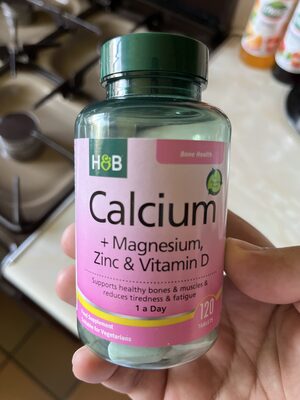
H&B Calcium + Magnesium Zinc & Vitamin D comes in a 120 tablets pack. It is sold under the H&B brand. On Mamori it sits under Groceries › Health Foods › Multivitamin Supplement. Its label lists 14 ingredients.
H&B Calcium + Magnesium Zinc & Vitamin D at a glance
H&B Calcium + Magnesium Zinc & Vitamin D fits Vegetarian, Pescatarian and Vegan + Eggs diets. It also carries the Gluten Free, Crustaceans Free, Egg Free, Fish Free, Peanut Free, Soy Free, Dairy Free, Tree Nut Free, Celery Free, Mustard Free, Sesame Free, Sulfite Free, Lupin Free, Mollusks Free, Artificial Flavourings Free, Barley Free, Beef Free, Citrus Fruit Free, Corn Free, Fructose Free, Gelatin Free, Lactose Free, Latex Free, No Added Sugars, Oats Free, Pork Free, Poultry Free, Rice Free, Rye Free, Seed Free and Wheat Free badges. Nutrition-wise, it's Low Calorie, Low Carbs, Low Salt/Sodium, Low Saturated Fat, Low Sugars, Low Fiber and Low Protein. Worth knowing: it's marked Non-Vegan, Non-Low FODMAP, Non-Vegan + Dairy, Contains Additives and Contains Emulsifier.
Diet and allergens
Suitable for vegetarian and pescatarian diets.
Not suitable for a vegan diet.
Free from all 14 major allergens: gluten, crustaceans, eggs, fish, peanuts, soy, milk, tree nuts, celery, mustard, sesame, sulphites, lupin and molluscs.
Based on Mamori's check of the ingredients on the label. Recipes change, so always read the pack if you have an allergy or intolerance.
Size: 120 tablets
Last updated 26 October 2026
Ingredients
Calcium Carbonate, Magnesium Oxide, Bulking Agent: Microcrystalline Cellulose, Zinc Gluconate, Glazing Agents, Hydroxypropyl Methylcellulose, Hydroxypropyl Cellulose, Emulsifier: Cross-Linked Sodium Carboxy Methyl Cellulose, Anti-Caking Agent: Magnesium Stearate, Magnesium Gluconate, Calcium Gluconate, Zinc Citrate, Vitamin D3: Cholecalciferol, Humectant: Glycerol
Additives
- E170: Calcium Carbonate, Chalk: Generally safe
Calcium carbonate (E170), also known as chalk, is a naturally occurring mineral made of calcium, carbon and oxygen. For food use it is purified, and it may come from sources such as limestone or shells.
It is mainly used as a white colourant, but it can also help with acidity control, anti-caking, or as a calcium source in some foods. It may be found in confectionery, chewing gum, bakery products, decorations and some supplements or fortified foods.
It is generally considered safe at normal food amounts. It is authorised for use in the EU after safety assessment, and the sources checked raise no concern for typical dietary exposure.
- E530: Magnesium Oxide (Acidity Regulator): Generally safe
Magnesium oxide (E530) is a mineral compound made from magnesium and oxygen. It is a white, powdery substance and is used in food as an acidity regulator and anti-caking agent.
It helps control acidity and keeps powders free-flowing by reducing clumping. It may be used in powdered foods and ingredients where moisture can cause caking, such as dry mixes or seasonings.
Magnesium oxide is generally considered safe at normal food-use amounts. It is authorised for use in the EU after safety assessment, and the sources checked raise no specific concern for typical dietary exposure.
- E460: Cellulose (I) Microcrystalline Cellulose (Ii) Powdered Cellulose: Generally safe
Cellulose (E460) is a plant fibre and a form of carbohydrate found naturally in the cell walls of plants. As an additive it includes microcrystalline cellulose and powdered cellulose, usually made from purified plant material such as wood pulp or cotton.
It is used as a thickener, stabiliser, anti-caking agent and bulking agent. It can help improve texture, keep ingredients evenly mixed, or stop powders from clumping, and may be found in foods such as grated cheese, sauces, bakery products, low-energy foods and powdered mixes.
Cellulose (E460) is generally considered safe. It is allowed in food in the EU after EFSA safety assessment, and the sources checked raise no concern at normal amounts.
- E464: Hydroxypropyl Methyl Cellulose: Generally safe
Hydroxypropyl methyl cellulose, or E464, is also called hypromellose. It is a modified cellulose, made from plant fibre cellulose that has been chemically adjusted so it dissolves and works well in water.
In food, E464 acts as a thickener, stabiliser and emulsifier. It helps improve texture, hold mixtures together, and control moisture. It may be used in products such as sauces, bakery fillings, desserts, processed foods, and some gluten-free or reduced-fat foods.
It is generally considered safe. E464 is allowed in food in the EU after safety assessment, and the sources checked raise no concern at normal amounts.
- E463: Hydroxypropyl Cellulose: Generally safe
Hydroxypropyl cellulose (E463) is a modified cellulose, made by chemically changing cellulose from plant fibres. It is a water-soluble substance used as a thickener, stabiliser and emulsifier.
In food, it helps improve texture, keep mixtures even, and control thickness. It may be used in products where a smooth or stable texture is needed, such as sauces, desserts, processed foods and some coatings.
It is generally considered safe at normal food amounts. E463 is authorised for use in the EU after safety assessment by EFSA, and the sources checked raise no specific concern for typical dietary exposure.
- E466: Sodium Carboxy Methyl Cellulose, Cellulose Gum: Generally safe
Sodium carboxy methyl cellulose, also called cellulose gum or E466, is a modified cellulose. Cellulose is a natural fibre found in plant cell walls, and E466 is made by chemically changing it so it dissolves or disperses in water.
It is used as a thickener, stabiliser and emulsifier. It helps give foods a smooth texture, keep ingredients mixed, and control thickness. It can be found in products such as sauces, dressings, desserts, ice cream, baked goods and some reduced-fat foods.
E466 is generally considered safe. It is authorised for use in the EU after safety assessment, and the sources checked raise no concern at normal food amounts.
- E572: Magnesium Stearate, Calcium Stearate (Emulsifier): Not allowed in the EU (Regulation (EC) No 1333/2008, Article 4(1) and Annex II)
Magnesium stearate and calcium stearate, E572, are salts of stearic acid, a fatty acid found in vegetable and animal fats. They are waxy, powdery substances used in very small amounts.
In food, E572 is mainly used as an anti-caking agent, flow aid, or emulsifier. It helps powders stay free-flowing and can help ingredients mix more evenly. It may be used in powdered foods, food supplements, tablets, and some processed products where smooth handling is needed.
E572 is allowed in the EU within set limits. Its safety is assessed through normal food additive controls, but this app has not rated it yet.
- E580: Magnesium Gluconate: Generally safe
Magnesium gluconate, sometimes referred to as E580, is a magnesium salt of gluconic acid. It is used as a source of the mineral magnesium rather than being treated as a food additive under EU law.
It may be added to foods to increase their magnesium content, such as fortified foods or products with added minerals. Similar mineral salts can also help with acidity control or powder flow, but its EU role is as a nutrient source.
It is generally considered safe when used as a permitted magnesium source in food. In the EU, it is listed as a form of magnesium that may be added to foods.
- E578: Calcium Gluconate: Generally safe
Calcium gluconate (E578) is a calcium salt of gluconic acid, a mild acid made when glucose is fermented or oxidised. It is a mineral-based food additive and can also act as a source of calcium.
In food, it is used mainly to regulate acidity, help keep ingredients free-flowing, or firm certain foods. It may be used in products where calcium salts are useful for texture, stability, or pH control.
Calcium gluconate is generally considered safe at normal food amounts. It is authorised for use in the EU after safety assessment, and the sources checked raise no concern for typical dietary exposure.
- E422: Glycerol (Emulsifier): Generally safe
Glycerol, or E422, is a clear, sweet-tasting liquid also known as glycerine. It is a type of sugar alcohol and can be made from vegetable oils, animal fats, or produced synthetically.
In food, it helps keep moisture in, thickens texture, stabilises mixtures, and can help emulsions stay smooth. It is used in a range of foods where softness, moisture retention, or smooth texture is needed, such as confectionery, baked goods, icings, and some drinks.
Glycerol is generally considered safe at normal food amounts. It is allowed in food in the EU after safety assessment, and the sources checked raise no concern for typical use.
Questions and answers
Is H&B Calcium + Magnesium Zinc & Vitamin D vegan?
No. It is not suitable for a vegan diet.
Is H&B Calcium + Magnesium Zinc & Vitamin D vegetarian?
Yes. It is suitable for a vegetarian diet.
Is H&B Calcium + Magnesium Zinc & Vitamin D suitable for a pescatarian diet?
Yes. It is suitable for a pescatarian diet.
Is H&B Calcium + Magnesium Zinc & Vitamin D suitable for a Low FODMAP diet?
No. It is not suitable for a Low FODMAP diet.
Is H&B Calcium + Magnesium Zinc & Vitamin D suitable for a Vegan + Dairy diet?
No. It is not suitable for a Vegan + Dairy diet.
Is H&B Calcium + Magnesium Zinc & Vitamin D suitable for a Vegan + Eggs diet?
Yes. It is suitable for a Vegan + Eggs diet.
Is H&B Calcium + Magnesium Zinc & Vitamin D gluten-free?
Yes. Its ingredients include no gluten, and its label gives no gluten warning.
Does H&B Calcium + Magnesium Zinc & Vitamin D contain milk?
No. Its ingredients include no milk, and its label gives no milk warning.
Is H&B Calcium + Magnesium Zinc & Vitamin D nut-free?
Yes. Its ingredients include no peanuts or tree nuts, and its label gives no nut warning.
Does H&B Calcium + Magnesium Zinc & Vitamin D contain eggs?
No. Its ingredients include no eggs, and its label gives no egg warning.