
Boost Tropical Sport 500 ml
Boost
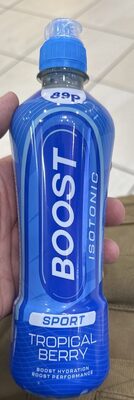
Boost Tropical Sport comes in a 500 ml pack. It is sold under the Boost brand. On Mamori it sits under Beverages › Energy & Sports Drinks › Sport Drinks. Its label lists 19 ingredients.
Boost Tropical Sport at a glance
Boost Tropical Sport fits Vegan, Vegetarian, Pescatarian, Vegan + Dairy and Vegan + Eggs diets. It also carries the Gluten Free, Crustaceans Free, Egg Free, Fish Free, Peanut Free, Soy Free, Dairy Free, Tree Nut Free, Celery Free, Mustard Free, Sesame Free, Lupin Free, Mollusks Free, Barley Free, Beef Free, Citrus Fruit Free, Gelatin Free, Lactose Free, Latex Free, Oats Free, Pork Free, Poultry Free, Rice Free, Rye Free, Seed Free and Wheat Free badges. Nutrition-wise, it's Low Calorie, Low Carbs, Low Salt/Sodium, Low Saturated Fat, Low Fiber, Low Protein and Medium in Sugars. Worth knowing: it's marked Non-Low FODMAP, Contains Additives, Contains Artificial Flavourings, Contains Corn, Contains Emulsifier, Contains Fructose and Contains Added Sugars.
Diet and allergens
Suitable for vegan, vegetarian and pescatarian diets.
Free from gluten, crustaceans, eggs, fish, peanuts, soy, milk, tree nuts, celery, mustard, sesame, lupin and molluscs.
Based on Mamori's check of the ingredients on the label. Recipes change, so always read the pack if you have an allergy or intolerance.
Size: 500 ml
Last updated 26 October 2026
Ingredients
Water, Glucose-Fructose Syrup, Acid: Citric Acid, Mineral Salts, Sodium Chloride, Potassium Citrate, Calcium Lactate, Magnesium Chloride, Flavourings, Dextrose, Preservatives, Potassium Sorbate, Dimethyl Dicarbonate, Sweeteners, Aspartame, Acesulfame K, Stabiliser: Acacia Gum, Vitamin B6, Colour: Brilliant Blue
Additives & flavourings
Additives
- E330: Citric Acid: Generally safe
Citric acid (E330) is a natural organic acid found in citrus fruits and many other plants. The citric acid used in food is usually made by fermentation of sugars using micro-organisms.
It is used as an acidity regulator and antioxidant. It helps give a sharp, sour taste, control pH, and slow colour or flavour changes. It is common in soft drinks, sweets, jams, sauces, canned foods, and many processed foods.
Citric acid is generally considered safe at normal food levels. It is allowed in food in the EU after safety assessment, and the sources checked raise no concern for typical dietary amounts.
- E332: Potassium Citrates (I) Monopotassium Citrate (Ii) Potassium Citrate (Tripotassium Citrate): Generally safe
Potassium citrates (E332) are potassium salts of citric acid, a natural acid found in citrus fruits. They include monopotassium citrate and tripotassium citrate, and are used as acidity regulators and antioxidants.
In food, they help control acidity, stabilise flavour, and can slow changes caused by oxidation. They may be used in products such as drinks, jams, confectionery, processed cheese, and other foods where acidity control is needed.
Potassium citrates are generally considered safe at normal food amounts. They are authorised for use in the EU after safety assessment, and the sources checked raise no concern for typical dietary exposure.
- E327: Calcium Lactate: Generally safe
Calcium lactate (E327) is the calcium salt of lactic acid. It is a white, water-soluble substance used as a source of calcium and as an acidity regulator in foods.
It helps control acidity, firm fruit and vegetables, and can support gelling or texture in some products. It may be found in foods such as canned fruit and vegetables, jams, cheese products, desserts, and fortified foods.
Calcium lactate is generally considered safe. It is allowed in food in the EU after safety assessment, and the sources checked raise no concern at normal amounts.
- E511: Magnesium Chloride: Some concerns
Magnesium chloride (E511) is a mineral salt made from magnesium and chloride. It is a naturally occurring substance and can be obtained from seawater, brines or mineral sources.
In food, it is used as an acidity regulator, firming agent and anti-caking agent. It may be used where manufacturers need to control acidity, improve texture, or help powdered ingredients flow more freely.
It is permitted for use in food, but there are some concerns about exposure. EFSA found that people who eat larger amounts of foods containing magnesium chloride could exceed the safe daily amount, so the risk is mainly linked to high overall intake.
- E202: Potassium Sorbate: Some concerns
Potassium sorbate (E202) is the potassium salt of sorbic acid. It is a preservative used to slow the growth of moulds and yeasts in food and drink.
It is often used in products where spoilage by yeasts or moulds is a concern, such as sauces, bakery fillings, cheese products, fruit preparations, drinks and some processed foods.
It is allowed in food, but some concerns have been raised. EFSA found that people who eat a lot of foods containing sorbates could go over the safe daily amount, so overall exposure is the main issue.
- E242: Dimethyl Dicarbonate: Generally safe
Dimethyl dicarbonate, or E242, is a preservative. It is a synthetic chemical that is added in very small amounts and breaks down after use, mainly into substances such as methanol and carbon dioxide.
It helps control yeasts, moulds and some bacteria, especially in drinks. It is typically used in beverages such as soft drinks, flavoured drinks, alcohol-free wine and other packaged drinks where spoilage control is needed.
It is generally considered safe at normal permitted levels. It is allowed in food in the EU after EFSA safety assessment, and the sources checked raise no concern for usual food use.
- E951: Aspartame: Some concerns
Aspartame (E951) is an artificial intense sweetener. It is made from two amino acids, aspartic acid and phenylalanine, joined with a small methanol component, and is much sweeter than sugar.
It is used to give sweetness with very little energy. It is found in many “diet” or “sugar-free” soft drinks, chewing gum, desserts, yoghurts, tabletop sweeteners and some medicines.
Aspartame is allowed for use, but some concerns have been raised. In 2023, IARC classed it as “possibly causing cancer” (Group 2B), while food safety bodies kept the acceptable daily intake; foods containing it must warn people with phenylketonuria that it contains phenylalanine.
- E950: Acesulfame K: Generally safe
Acesulfame K, also called acesulfame potassium or E950, is an artificial sweetener. It is a potassium salt of a synthetic sweet-tasting compound and is much sweeter than sugar, so only small amounts are used.
It is used to sweeten foods and drinks without adding much energy. It is often found in sugar-free or reduced-sugar soft drinks, desserts, chewing gum, tabletop sweeteners and some special dietary foods.
It is generally considered safe at normal amounts. It is authorised for use in the EU after safety assessment, and the sources checked raise no concern when it is used within permitted limits.
- E414: Gum Arabic (Acacia Gum): Generally safe
Gum arabic, or acacia gum, is E414. It is a natural gum obtained from the dried sap of acacia trees. It is a soluble dietary fibre made mainly of complex carbohydrates.
In food, it is used as a thickener, stabiliser and emulsifier. It helps keep mixtures even, improves texture, and can help hold flavours or colours in place. It may be found in sweets, soft drinks, icings, baked goods and flavourings.
It is generally considered safe at normal food amounts. It is authorised for use in the EU after safety assessment, and the sources checked raise no concern for typical use.
- E133: Brilliant Blue Fcf (Fd&C Blue 1): Some concerns
Brilliant Blue FCF (E133), also known as FD&C Blue 1, is a synthetic blue food colour. It is a water-soluble dye made from petroleum-derived chemical compounds.
It is used to give foods and drinks a bright blue colour, or mixed with other colours to make shades such as green or purple. It can be found in sweets, soft drinks, desserts, ice lollies, decorations and some processed snack foods.
It is allowed for use, but some concerns have been raised. EFSA found that people who eat a lot of foods containing E133 may exceed the safe daily amount, so over-exposure is the main issue.
Flavourings
- Flavourings: Flavouring (Regulation (EC) No 1334/2008 on flavourings, Article 16).
Questions and answers
Is Boost Tropical Sport vegan?
Yes. It is suitable for a vegan diet.
Is Boost Tropical Sport vegetarian?
Yes. It is suitable for a vegetarian diet.
Is Boost Tropical Sport suitable for a pescatarian diet?
Yes. It is suitable for a pescatarian diet.
Is Boost Tropical Sport suitable for a Low FODMAP diet?
No. It is not suitable for a Low FODMAP diet.
Is Boost Tropical Sport suitable for a Vegan + Dairy diet?
Yes. It is suitable for a Vegan + Dairy diet.
Is Boost Tropical Sport suitable for a Vegan + Eggs diet?
Yes. It is suitable for a Vegan + Eggs diet.
Is Boost Tropical Sport gluten-free?
Yes. Its ingredients include no gluten, and its label gives no gluten warning.
Does Boost Tropical Sport contain milk?
No. Its ingredients include no milk, and its label gives no milk warning.
Is Boost Tropical Sport nut-free?
Yes. Its ingredients include no peanuts or tree nuts, and its label gives no nut warning.
Does Boost Tropical Sport contain eggs?
No. Its ingredients include no eggs, and its label gives no egg warning.
More in Sport Drinks
- Gatorade cool blue
- Lucozade Sport Custom Sport Orange
- Lucozade Raspberry
- Lucozade sport mango passionfruit
- Gatorade Blood Orange Flavor
- Bever Mas+ By Messi Lemon Lime Punch
- Prime Hydration Drink Ice Orange
- Prime Hydration Ice Blue Chill
- Prime Hydration Juventus
- Prime Hydration Ice Pop
- Boost Sport Raspberry & Mango
- Boost Sport Mixed Berry